
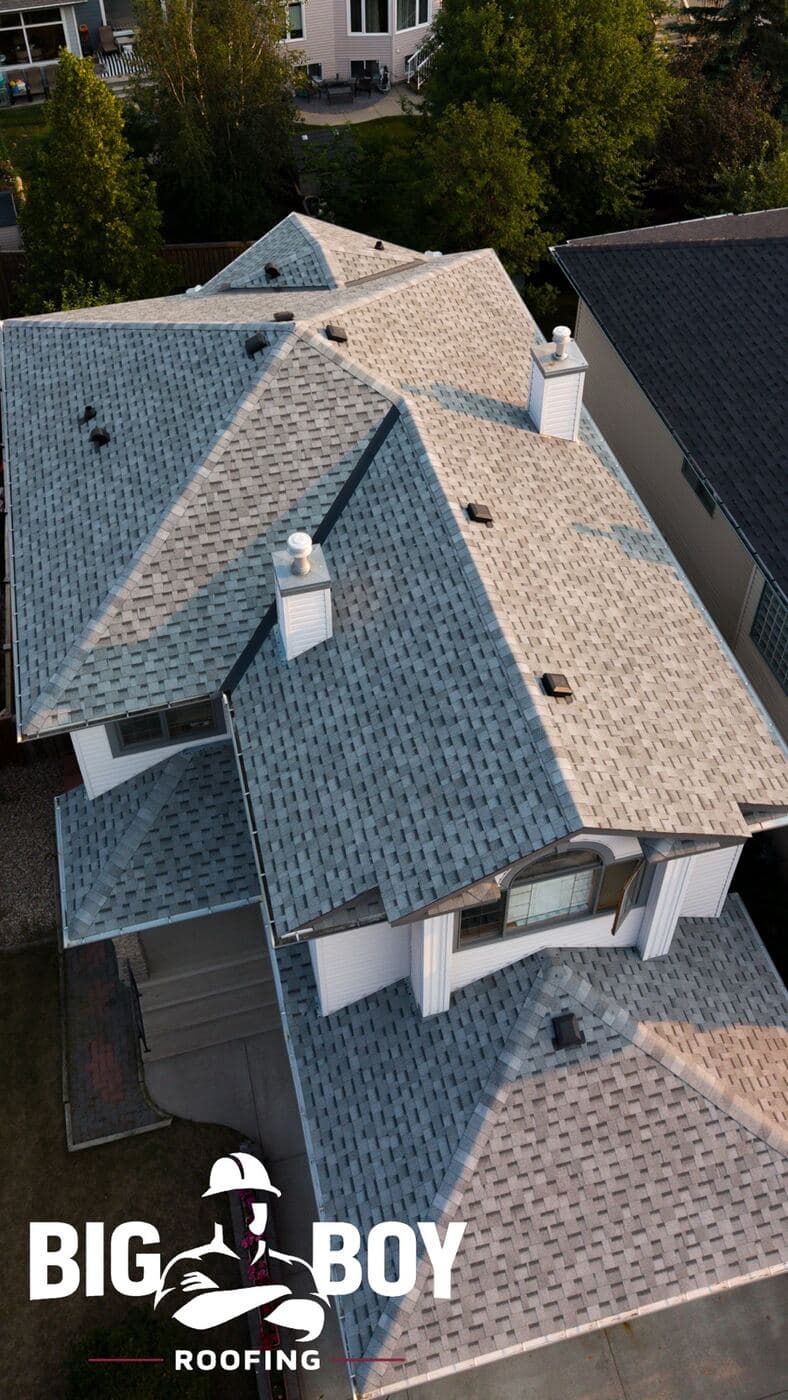
The lights are the fun part. What decides whether your house is better or worse off in five years is what the lights are fastened to.
Permanent roofline lighting mounts at the eave, the lower edge of the roof. That's the busiest strip on the outside of your house. It's where water leaves the roof, where the eavestrough hangs, where the attic draws in air through the soffit, and where ice builds up in winter. Every clip or screw holding a lighting channel is a hole in that assembly. Done well, that's not a problem. Done carelessly, it's a slow leak you find years later.
This article covers the roof side of the job. For the hardware itself, start with how permanent roofline lighting works.
What the fasteners should go into
The eave has a few layers, and it helps to know them before an installer starts pointing.
The fascia is the vertical board along the roof edge. On many houses it's wood covered by an aluminum wrap. The soffit is the underside of the overhang, often vented aluminum or vinyl panels. The drip edge is the metal strip at the very edge of the roof that sends water off the deck and into the eavestrough.
A channel should fasten into something that will hold it for years: sound wood fascia, reached through any aluminum cover, below the drip edge, or solid material in the soffit close to the fascia. Aluminum fascia wrap is a thin cover, not structure. If the wood behind it is soft or rotten, which can happen on older houses, the fastener has nothing to bite into and will work loose. The right order is to repair the fascia first, then mount the lights. Soffit and fascia explained covers what those parts do.
- Good: sealed fasteners into sound fascia, below the drip edge.
- Good: fasteners into solid soffit material near the fascia, clear of the vented panels.
- Bad: anything through the drip edge or up under the shingles.
- Bad: fasteners into aluminum wrap with soft or rotten wood behind it.
Why the roof deck and shingles are off limits
Some installs put clips on top of the roof, through the shingles, or drive fasteners up into the roof deck from the edge. It's quick. It's also a mistake.
Shingles work by overlapping. Water runs over each course and onto the one below, and the nails holding each shingle are covered by the course above. A new fastener through that surface is an opening water can find. On the lowest courses, just above the eave, it's exactly where meltwater backs up in winter. A dab of sealant over a screw head is a short-term patch, not a roofing detail.
There's a warranty problem too. IKO's Canadian shingle warranty, as one example, excludes damage that arises after the roof is altered following the original installation, including equipment installations. It also excludes the cost of repairs made with another company's materials unless IKO authorized them in writing in advance. Its main coverage is for manufacturing defects that significantly affect how the shingles shed water, not for leaks caused by later work. Read your own warranty to see how an alteration could affect a claim.
Water and ice-dam risk at the eave
In winter, the eave is where trouble concentrates. Natural Resources Canada explains how ice dams form: heat escaping from the house melts snow on the roof, the water runs down to the cold overhang, and if the air and the overhang are below freezing, the water freezes there and starts a dam. Water that backs up behind the ice can work its way under shingles and into the roof edge.
Lighting doesn't cause ice dams, but a poor install can make the damage worse when they happen. Watch for these:
- Fasteners placed so water runs down the back of the fascia instead of into the eavestrough.
- Channel mounted over or against the drip edge, interrupting the path from the shingles into the eavestrough.
- Unsealed holes in the fascia that let water into the wood, where it freezes, swells and rots the board over a few seasons.
- Channel or wiring sitting in the ice line, where it gets pried loose as ice forms and lets go.
Don't block the soffit vents
Most sloped-roof attics breathe in at the soffits and out near the ridge. Outside air comes in through vented soffit panels, moves up under the roof deck and leaves through roof or ridge vents. Natural Resources Canada notes that a well-sealed and insulated attic keeps the roof cool and generally won't have ice dams, and its advice is to make sure existing attic vents are working properly and not blocked by insulation, debris or other materials.
A lighting channel run flat across vented soffit panels counts as other materials. So does a power supply or a bundle of wiring stuffed into the soffit. IKO's Canadian shingle warranty excludes damage caused by inadequate ventilation, including blocked vents, and says ventilation must be distributed evenly between the rooftop and the eaves. Blocking the intake can be a problem for the attic and for the warranty.
If the channel has to go on the soffit, it should run along a solid strip near the fascia with the vented area left open. Attic ventilation explained covers how the whole system works.
How third-party work can affect your roofing warranties
A newer roof usually comes with two warranties: the manufacturer's on the shingles, and the contractor's workmanship warranty on the installation. Lighting can touch both.
On the manufacturer side, the exclusions to read are the ones above, for later alterations, equipment installations and blocked ventilation. On the workmanship side, read your roofing contract for anything about other trades, alterations or penetrations made after the job. A roofer can't be expected to stand behind holes someone else made, and the time to find out what yours says is before the drill comes out.
The practical steps are simple:
- Find your roofing contract and the shingle manufacturer's warranty before you get lighting quotes.
- Read the exclusions covering alterations, penetrations, other trades and ventilation.
- Ask your roofer, in writing, whether the planned mounting method would affect their warranty.
- Share the answer with the lighting installer, and make the mounting method part of their written quote.
Electrical permits in Alberta, at a high level
The lights run on low voltage, but the power supply connects to your house wiring, and that's where permits come in. Alberta's Safety Codes Act requires permits before work on the systems it covers. The Safety Codes Council notes that both local bylaws and provincial regulations govern when you need one, and its advice is to check with your municipality before starting.
In Calgary, the City says an electrical permit is required for all new wiring and whenever existing branch circuit wiring is extended or altered, and isn't required when you're only replacing fixtures. A homeowner permit is only for an owner who lives in the home and does the work personally. You can't take one out on behalf of a company doing the work.
In practice, plugging a power supply into an existing exterior outlet is a different job from adding a new outdoor outlet, running a new circuit or wiring a power supply into a junction box. Ask any installer exactly how the power connection will be made, who is making it, and whether it's under a permit. Rules can differ outside Calgary, so confirm with your own municipality.
Questions to ask any installer
These separate installers faster than price does. Ask all of them, and get the important answers written into the quote. For what should be in the price, see what permanent lighting costs.
- Exactly what does the channel fasten into: fascia, soffit or roof deck? How is each fastener sealed?
- Will you check the wood behind my fascia first, and what happens if it's rotten?
- Where will the channel sit relative to the drip edge and the eavestrough?
- Will anything cover or block my soffit vents?
- How does the power supply connect to the house, who makes that connection, and is it under a permit?
- What's the warranty on the hardware, and separately on your workmanship, and who honours each one?
- Have you checked whether this affects my roofing warranty?
- Does any feature need a subscription to keep working?
Will permanent lights void my roof warranty?
They can affect it. IKO's Canadian shingle warranty, for example, mainly covers manufacturing defects, and it excludes damage arising from later alterations and equipment installations, and from blocked ventilation. Workmanship warranties have their own exclusions. Read both, and ask your roofer in writing before anyone drills.
Do I need an electrical permit for permanent lights in Alberta?
It depends on how the power is connected. In Calgary, new wiring and extending or altering a branch circuit need an electrical permit, while replacing a fixture doesn't. Check with your municipality, and ask your installer exactly how the connection will be made and who holds any permit.
Should permanent lights go on the fascia or the soffit?
Either can work. Fascia mounting is a frequent choice because the fascia sits right under the roof edge and, when sound, gives a fastener something solid to hold. Soffit mounting has to stay clear of the vents. What matters most is that fasteners go into solid material below the drip edge, not into the roof deck or shingles.
Can permanent lights be mounted on aluminum fascia?
Usually, as long as the wood behind the aluminum is sound, because the aluminum is only a cover. If that wood is soft or rotten, it should be repaired before a permanent fixture is fastened to it.
Can roofline lights cause ice dams?
The lights don't cause them. Ice dams form when heat melts snow that then refreezes at the cold eave. But fasteners in the wrong place, blocked soffit vents or channel over the drip edge can make the damage worse when ice does form.
Where the facts on this page come from. If a source has changed since we last checked, tell us and we'll fix the page.
- Limited Warranty Information for Asphalt Shingles (Canada) · IKO
- Keeping The Heat In, Section 5: Roofs and attics · Natural Resources Canada
- Homeowner electrical and plumbing permits · City of Calgary
- Permit Information · Safety Codes Council