HOMEFLAT & LOW-SLOPE
FLAT & LOW-SLOPE

FLAT AND LOW-SLOPEROOFING IN CALGARY.

A flat roof doesn't shed water — it holds it until the drains work. Everything about how it's inspected, repaired and claimed follows from that.

  • INSPECT · REPAIRALL FIVE SYSTEMS
  • ASSESSEDON THE ROOF
CALGARY CREW · OPEN BOOKING

A sloped roof survives a bad detail because gravity is on its side — water that gets past a shingle usually finds its way off the roof before it finds its way in. A flat roof has no such margin. Water sits on it until the drains take it away, so every seam, every flashing, every penetration and every drain is load-bearing in a way nothing on a shingle roof is.

That changes what an inspection is. You cannot assess a flat roof from the ground or from a photo. You walk it, you look at every seam and every curb, you check whether water is standing where it shouldn't be, and on a gravel roof you have to move gravel to see anything at all. Most flat-roof quotes in Calgary are written without any of that happening.

What your roof probably is

Five systems cover essentially every flat roof in Calgary. Knowing which one you have changes what a repair costs and whether replacement is even the right conversation.

  • Gravel on top — built-up roofing (BUR), the tar-and-gravel roof. Extremely common on older Calgary commercial and on 1960s–70s residential flat sections.
  • A white or grey membrane with welded seams — TPO. The default on most new Calgary commercial construction.
  • A black rubber membrane with taped seams — EPDM. Common on older commercial and on residential flat sections.
  • A rolled asphalt sheet, often with granules on top, in two or more layers — modified bitumen. The usual choice for residential flat sections.
  • A membrane over a restaurant or industrial building — quite possibly PVC, which is the one that tolerates grease.

Ponding water is the question that decides everything

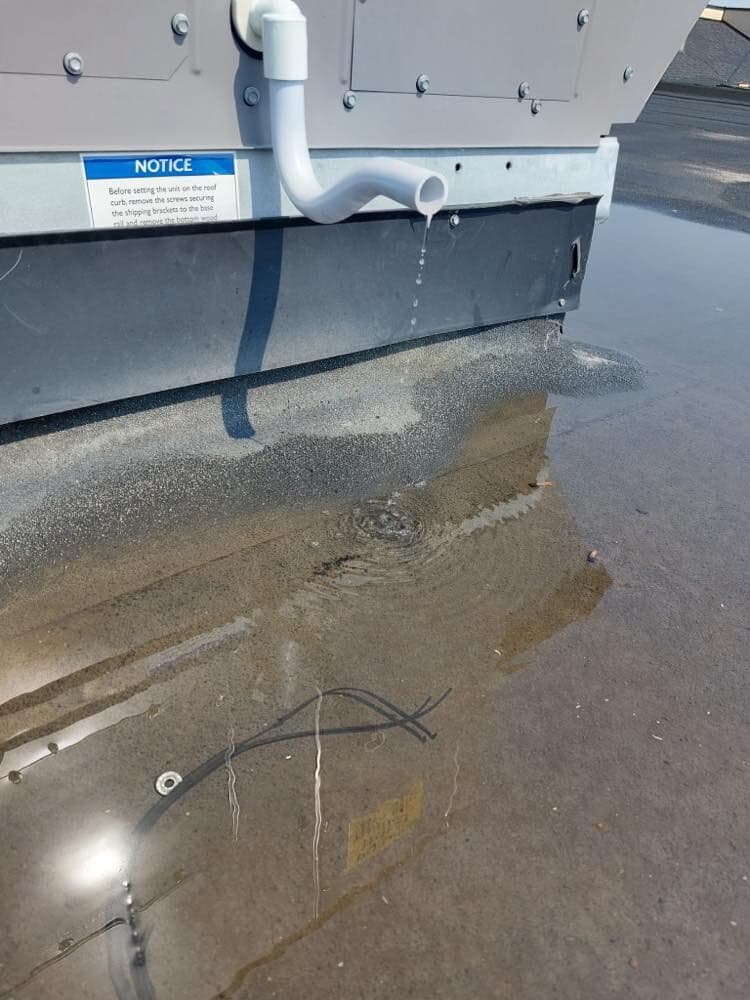
If water is still standing on your roof 48 hours after it stopped raining, that's ponding, and it is the single most useful diagnostic on a flat roof. It means drainage has failed — blocked drains, a sagging deck, or a roof that was never sloped properly to begin with. Ponding accelerates membrane degradation, and in Calgary it does something worse: it freezes. Ice expands into every seam and micro-crack it can find, and does it again every freeze-thaw cycle. Fixing the membrane without fixing the drainage is resurfacing a problem rather than solving it.

What Alberta specifically does to a flat roof

Three things, and they compound.

  • Temperature swing. A Calgary chinook can move 30°C in a day. Every material on the roof expands and contracts through that range, and it is the seams and the flashings at parapets and curbs that absorb the movement. This is why marginal seam work fails here faster than it would almost anywhere else in Canada.
  • Snow load, then meltwater. Snow sits on a flat roof rather than shedding. It melts from below against a warm deck, runs to the cold perimeter and refreezes, which is the flat-roof version of an ice dam and considerably harder to see.
  • Hail. Hail on a membrane roof does not look like hail on a shingle roof — it bruises and fractures the membrane, and on a gravel BUR roof it drives stone into the bitumen. It is routinely missed on claims because the inspector was looking for shingle damage.

Repair is more often the right answer than you'd think

Flat roofs get written off early, particularly BUR. A tar-and-gravel roof with localised failures around a curb or a drain is frequently repairable for a small fraction of a replacement, and the gravel that makes it hard to inspect is also what has protected the membrane for thirty years. The honest markers for replacement are widespread saturation of the insulation below, failures across multiple areas rather than at identifiable points, and a membrane that has genuinely reached the end of its service life. One failed seam is a repair.

Hail claims on flat roofs

Flat-roof hail damage is under-documented more consistently than any other category we see. The damage signature is different — bruising and fracturing of the membrane, displaced gravel exposing bitumen, dented and split metal flashings, damaged drain baskets and mechanical curbs — and an inspector trained on shingles will walk across it without registering any of it. Test cuts are sometimes needed to establish whether the insulation below is saturated, and that is a decision to make with the adjuster present rather than unilaterally.

How to read a flat-roof quote

This is where two quotes stop being comparable, and it is almost never about the membrane.

  • Is the existing roof being torn off, or is this an overlay? An overlay is cheaper and buries whatever is wrong underneath it. There are also code limits on how many layers a deck can carry.
  • Is wet insulation being replaced? Saturated insulation under a new membrane guarantees the new roof fails early, and a core sample is the only way to know.
  • Is drainage being corrected, or just re-covered? If you had ponding before, you will have ponding after unless somebody addressed it.
  • Membrane thickness — measured in mils. A 45-mil and a 60-mil TPO roof are not the same product and the price difference between two quotes is often exactly this.
  • How are the seams made, and by whom? On a welded system this is the entire roof.
  • Perimeter and curb flashing detail. Most flat roofs fail at the edges and the penetrations, not in the field.
THE FIVE SYSTEMS

WHAT'S ACTUALLY ON YOUR ROOF.

If you're holding two quotes naming different products and neither explains the difference, this is that explanation. Each of these fails differently, which is why the same damage means different things depending on which one you have.

TPO

Thermoplastic Polyolefin
WHAT IT IS

A single-ply membrane, usually white, mechanically fastened or fully adhered to the deck and hot-air welded at the seams. The welded seam is the defining feature — done correctly it is as strong as the sheet itself.

BEST FOR

Commercial and multi-unit low-slope roofs, and the current default on most new Calgary commercial construction.

HOW IT FAILS

Seams first, nearly always. A cold weld or a rushed weld looks identical to a good one on install day and opens up three winters later. After that, punctures from foot traffic and mechanical work, and shrinkage pulling at the perimeter flashing.

IN ALBERTA SPECIFICALLY

The white surface is a real advantage in a Calgary summer and irrelevant in January. What matters more here is that Alberta's temperature swing is brutal on seams — the membrane expands and contracts across a range most of North America never sees, and a marginal weld fails faster here than it would in Ontario.

TYPICAL SERVICE LIFE20–30 years, heavily dependent on seam quality and membrane thickness.

EPDM

Ethylene Propylene Diene Monomer
WHAT IT IS

A synthetic rubber single-ply membrane, typically black, ballasted, mechanically fastened or fully adhered. Seams are made with adhesive tape rather than heat.

BEST FOR

Low-slope roofs where budget and proven longevity matter more than reflectivity. Common on older Calgary commercial stock and on residential flat sections.

HOW IT FAILS

Seam adhesive degrading over time, shrinkage pulling flashings away from parapets and curbs, and punctures. EPDM is more puncture-resistant than TPO but its seams age differently — taped seams degrade gradually where welded seams tend to fail suddenly.

IN ALBERTA SPECIFICALLY

Black membrane absorbs heat, which is a summer penalty and a genuine winter advantage — it sheds snow load faster than a white roof does. On a Calgary building with marginal structural capacity that can matter more than the cooling cost.

TYPICAL SERVICE LIFE20–30 years, and it is the system with the longest real-world track record.

Modified Bitumen

Modified Bitumen (SBS / APP)
WHAT IT IS

Asphalt modified with rubber or plastic polymers, supplied in rolls and installed in two or more plies. Applied by torch, by hot asphalt, by cold adhesive, or as a self-adhered sheet.

BEST FOR

Residential flat sections, small commercial, and anywhere a multi-ply redundancy is wanted. SBS-modified is the common choice in cold climates because it stays flexible.

HOW IT FAILS

Blistering between plies where moisture was trapped at install, splitting at movement points, and granule loss on cap sheets. Multi-ply means a single breach doesn't immediately become a leak, which is genuinely the system's best property.

IN ALBERTA SPECIFICALLY

SBS-modified bitumen is the right modified-bitumen choice for Calgary specifically — the SBS rubber modifier keeps the sheet flexible at low temperature, where APP (plastic-modified) goes brittle. Torch application also needs a hot-work permit and a fire watch, which is a real scheduling and safety consideration on an occupied building.

TYPICAL SERVICE LIFE15–25 years depending on plies, surfacing and installation quality.

Built-Up

Built-Up Roofing (BUR, tar and gravel)
WHAT IT IS

The original flat roof: alternating layers of bitumen and reinforcing felt, built up in plies, usually topped with gravel. What most people mean by 'a tar and gravel roof'.

BEST FOR

It is rarely specified new any more, but it is on an enormous amount of existing Calgary commercial and older residential stock, and it is repairable.

HOW IT FAILS

Alligatoring of the exposed bitumen, blistering, gravel displacement exposing the membrane, and splitting at movement joints. The gravel makes inspection harder — damage hides under it, which is exactly why a proper flat-roof inspection is not a walk-around.

IN ALBERTA SPECIFICALLY

Calgary has a lot of BUR, and it is the system most often written off prematurely. A BUR roof with localised failures is frequently repairable for a fraction of a replacement, and the gravel that makes it hard to assess is also what has protected it for thirty years. Anyone recommending full replacement without a proper survey is guessing.

TYPICAL SERVICE LIFE20–30 years, and plenty of Calgary BUR roofs have run longer.

PVC

Polyvinyl Chloride
WHAT IT IS

A single-ply membrane, hot-air welded like TPO but chemically different — notably more resistant to grease, oils and chemical exposure.

BEST FOR

Restaurants and any building with kitchen exhaust, and industrial roofs with chemical exposure. Grease destroys TPO and EPDM; PVC tolerates it.

HOW IT FAILS

Seams, as with any welded membrane, plus plasticiser migration over time making older PVC brittle. Modern formulations are much better at this than 1980s PVC was.

IN ALBERTA SPECIFICALLY

If your building has a commercial kitchen, this is the conversation. A TPO roof under a grease exhaust fan fails in a fraction of its rated life, and it is one of the more common avoidable specification mistakes we see.

TYPICAL SERVICE LIFE20–30 years.
SEEN ON REAL ROOFS

Two Calgary flat roofs documented in August 2026 — water coming through a retail ceiling and a roof at the end of its life. Ponding, failed pitch pockets and an open curb seam, photographed.

WHERE WE'RE MOST USEFUL

Inspection, repair and claim documentation. Seams, curbs, drains, flashings, blisters, splits and storm damage — that's where the large majority of flat-roof problems actually live, and it's where the gap between us and a shingle-trained inspector is widest. Flat-roof hail damage is the most consistently under-documented category we see.

Full replacement we scope per building and per system, so ask and we'll walk you through it. But we'd rather tell you your roof is repairable than sell you a replacement it doesn't need — flat roofs get written off early, built-up ones especially.

QUESTIONS

STRAIGHT ANSWERS.

Is my roof actually flat?

Almost certainly not, and that matters. A roof that reads as flat is normally built with a slight slope — commonly a quarter-inch per foot — to move water to the drains. A genuinely dead-level roof is a design problem. If yours ponds, the question is whether the slope was never there or whether the deck has sagged, and those have very different fixes.

Water is standing on my roof days after it rained. How urgent is that?

Urgent enough to look at before winter. Ponding degrades the membrane, adds real structural load, and in Calgary it freezes and works ice into every seam. It rarely causes a leak the week you notice it and it reliably causes one eventually.

Can a flat roof be repaired, or does the whole thing have to go?

Repaired, far more often than people are told. Localised failures at a curb, a drain or a seam are repairs. Replacement is the answer when the insulation below is broadly saturated, when failures are spread across the roof rather than at identifiable points, or when the membrane has genuinely aged out. We'll tell you which one you have and show you why.

Which system should I put on?

It depends on the building, not on which product a contractor prefers selling. A restaurant with kitchen exhaust needs PVC, because grease destroys TPO and EPDM. A residential flat section over a bedroom is usually modified bitumen. A large commercial low-slope is usually TPO or EPDM, and the choice between them turns on reflectivity, snow-shedding and budget. Anyone who recommends the same system for every building is telling you what they stock.

How do I know if my flat roof has hail damage?

You mostly can't from the ground, and a shingle-trained inspector will miss it on the roof. The signature is membrane bruising and fracturing, displaced gravel on a BUR roof, dented and split metal flashings, and damage to drain baskets and mechanical curbs. If your building was in a documented storm and the flat roof was never assessed by someone who knows what they're looking at, it's worth doing.

Do you do full flat-roof replacements, or only repairs?

Both — replacement is scoped per building and per system, so ask us about yours and we'll walk you through it. Where we're most useful, and what we lead with, is inspection, repair and claim documentation: that's where the large majority of flat-roof problems actually are, and it's where the gap between us and a shingle-trained inspector is widest. We'd also rather tell you a roof is repairable than sell you a replacement it doesn't need. Flat roofs get written off early, built-up ones especially.
RELATED
NOT READY TO TYPE AN ADDRESS?

WE'LL GET BACK TO YOU.

Drop your name and a way to reach you. We'll follow up with next steps — no pressure, no sales call.

OR REACH US DIRECTLY
EMAILcontact@bigboyroofing.ca
REACH THE CREW
FORM · CB

Giving us your number means you're okay with us calling or texting you about your roof — scheduling and quote updates, nothing else. Reply STOP anytime.

MESSAGE