
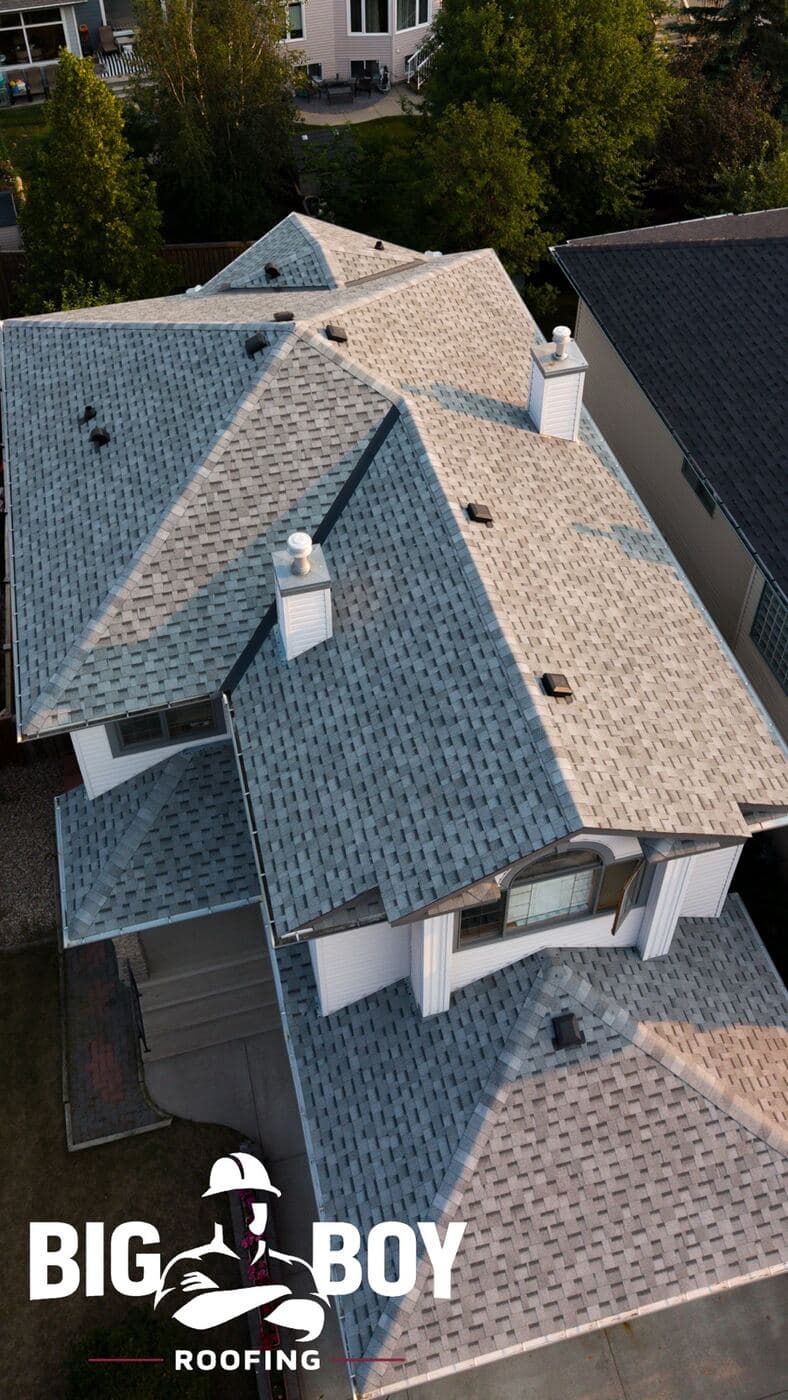
Permanent roofline lighting stays on the house all year. A low-profile channel runs along the edge of the roof, the lights sit inside it, and you control colour, brightness and schedules from your phone. In daylight it should look like part of the trim. After dark it can be plain warm white every night, or colours for whatever you're celebrating.
This article explains the parts and how they work together, so you can follow what an installer is telling you and ask better questions. How it fastens to your house, and why that's a roofing question as much as a lighting one, is covered in roofline lighting and your roof. If you want to see how we install it, that's on how our lighting works.
The four parts of the system
Whatever the brand, permanent systems are built from the same basic pieces. The differences are in build quality, the app, and the details of the channel.
| Part | What it does | What to ask |
|---|---|---|
| Channel or track | A slim extrusion, usually aluminum, fastened along the roof edge. It holds the lights and hides the wiring. | What colour and profile is it, and exactly what does it fasten into? |
| Addressable LEDs | Lights on a strip or string, each with a small chip so they can be controlled individually or in small groups. | How closely are the lights spaced, and can a failed section be replaced on its own? |
| Power supply | Converts household power into the low-voltage DC the lights run on. | Where will it live, and how will it connect to the house power? |
| Controller | Sends instructions down the data line and connects to your wifi and the app. | How many zones can it handle, and does anything need a subscription? |
What addressable actually means
An ordinary string of lights is one circuit. Everything is on or off, and every bulb is the same colour. Addressable LEDs work differently. Each light, or small group of lights, has its own tiny control chip. The controller sends a stream of data down the line, and each chip takes the instructions meant for it and passes the rest along.
That's how one gable can glow warm white while another is dimmed, or how colour can fade and travel along the roofline. Because the lights are chained together, the layout of the runs is planned before anything is mounted.
It's worth asking how a failure is handled: whether a single section can be replaced on its own, and whether that's covered by the hardware warranty.
Controllers, apps and scenes
The controller is the brain. It holds your settings and talks to the app, usually over your home wifi. In the app you pick colours, brightness, effects and schedules, and you group parts of the roofline into zones so they can be controlled separately. A saved look is usually called a scene.
Systems differ in ways you won't see in a brochure, so check these before you buy. For how the main systems compare, see comparing permanent lighting systems.
- Whether schedules keep running if your wifi drops, or only work while the controller is online.
- Whether any feature needs an ongoing subscription to keep working. Ask directly and get the answer in writing.
- How many zones the controller supports. If you might add the back of the house later, say so at the start.
- Whether you can try the app on a real phone before you sign, rather than looking at screenshots.
Power supplies and low voltage
The LEDs don't run on household power directly. A power supply converts it to low-voltage direct current, at the voltage the lights are designed for.
Distance matters. Along a long run, voltage drops in the wire and the far end can dim or shift colour. The fix is called power injection: extra power wires fed into the run at points along the way. A well-planned install works this out before anything is mounted.
The Canadian Electrical Code has a category called Class 2 circuits, which are limited in voltage and power. Ontario's Electrical Safety Authority, for example, describes a Class 2 power supply as one whose output can't exceed 100 volt-amperes, with an operating voltage of no more than 30 volts rms or 60 volts DC. Ask whether the power supply on your system is Class 2 rated. But the low-voltage side isn't the whole picture. The power supply still connects to your house wiring, and how that connection is made is what decides whether permitted electrical work is involved. That's covered in roofline lighting and your roof.
Where it mounts, and how it looks in daylight
The channel runs along the edge of the roof, in one of a few spots. Which one suits your house depends on the eave, the eavestrough and what's behind the trim.
- On the fascia. The fascia is the vertical board at the roof edge that the eavestrough hangs from. This is the most common spot.
- Just under the drip edge. The drip edge is the metal strip at the very edge of the roof. Mounting the channel on the fascia right below it keeps the lights shaded and hard to see from the street.
- On the soffit. The soffit is the underside of the overhang. The channel sits close to the fascia and has to stay clear of the soffit's vents.
How it behaves in a Calgary winter
Outdoor-rated systems are built to run in the cold, and the U.S. Department of Energy lists good performance in cold temperatures among the characteristics of LEDs. Winter is harder on everything around the lights.
Calgary's chinooks can swing a roof edge from frozen to dripping and back again in a short time. Each of those cycles works on seals, connectors and the fasteners holding the channel. Meltwater runs to the roof edge and refreezes, which puts ice exactly where the lights live, and snow sliding off the roof loads the eave too. None of that stops a well-installed system. It's why the weatherproofing at every connection, and the quality of the mounting, deserve close attention in a climate like Calgary's.
Weather matters most during installation. Fastening channel to icy fascia is harder to do well, so it's worth planning the install before winter sets in.
How long it lasts, and what wears out first
LEDs don't usually burn out like an old bulb. The U.S. Department of Energy notes that LED packages rarely fail catastrophically. Instead, their light output slowly declines. Lighting engineers often describe useful life with a figure called L70, the point where output has dropped to 70 percent of the original.
The same DOE fact sheet makes the more useful point for a homeowner: an LED product can fail because of any of its parts, including the electronics, wires, connectors, seals and weatherproofing, not only the LEDs. It also lists insufficient thermal management as a design flaw that can shorten product life, and notes that driver electronics often limit how long an LED product lasts. On a roofline system, that means the controller, the power supply and the connections matter to lifespan as well as the lights.
So when you compare systems, ask for the hardware warranty and the installer's workmanship warranty in writing, separately. Terms vary a lot in this category.
Can you see permanent roofline lights during the day?
Not much, if they're installed well. The channel is slim and sits tight to the fascia or soffit, so from the street it tends to read as trim or a shadow line. Standing under the eave looking up, you'll see it. Ask any installer to show you a finished house in daylight.
Do permanent LED lights work in extreme cold?
Outdoor-rated systems are designed for it, and the U.S. Department of Energy notes LEDs perform well in cold temperatures. What a Calgary winter tests is the installation: sealed connections, sound fascia, and fasteners that stay tight through repeated freeze-thaw cycles.
How long do permanent roofline lights last?
There isn't one number, because the lights, power supply, controller and connections all age differently. LEDs typically lose brightness gradually rather than failing suddenly. The written hardware and workmanship warranties are the practical measure of what's actually backed.
Do permanent lights need a subscription?
Some systems tie features to an ongoing fee and others don't. Before you buy, ask whether anything stops working if you don't pay, and get the answer in writing.
Can I install permanent roofline lighting myself?
Consumer kits exist. The two things to think hard about are what you fasten into at the roof edge and how the power supply connects to your house. In Calgary, new wiring or extending an existing circuit needs an electrical permit. Read roofline lighting and your roof before you drill anything.
Where the facts on this page come from. If a source has changed since we last checked, tell us and we'll fix the page.
- Solid-State Lighting Fact Sheet: Lifetime and Reliability · U.S. Department of Energy
- LED Basics · U.S. Department of Energy
- Exceptions to Product Approval Requirements · Electrical Safety Authority (Ontario)
- Homeowner electrical and plumbing permits · City of Calgary