
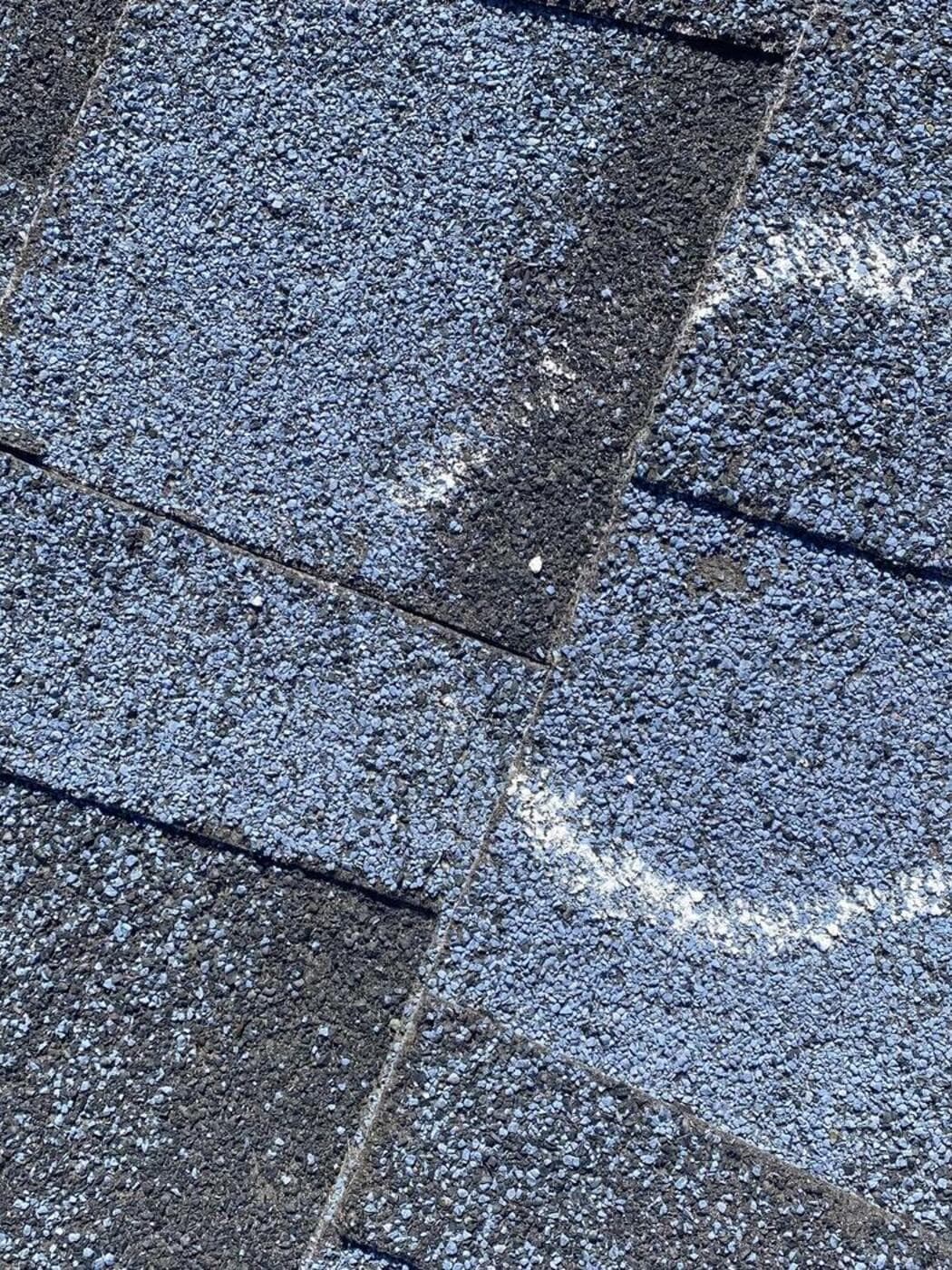
After a storm, every mark on a roof starts to look like hail. After ten years, every mark looks like age. Both can be wrong.
Asphalt shingles show a handful of problems that can look alike from the ground or in a phone photo. What separates them is the pattern across the roof, the shape of each mark up close, and what else on the house was hit. This guide explains what an inspector looks at. It's here so you can follow the reasoning in a report, not so you can diagnose your own roof from a ladder.
Why the cause matters
Two roofs can have the same number of marks and need completely different responses. Hail damage is a storm event, and home insurance policies generally deal with sudden damage from storms differently from wear and tear. Your policy wording decides what's covered. Blisters, weathering and nail problems come from age, the product or the installation, and the fix may be a repair, a warranty question or a replacement on your own schedule.
Getting the cause right also avoids two expensive mistakes: filing a claim on a roof that's simply old, and living with real hail damage because it was written off as wear.
Hail damage
The Insurance Institute for Business & Home Safety (IBHS) lists the signs of hail on an asphalt shingle roof:
- A random pattern of impact marks, not a line or a cluster in one spot.
- Bruising: soft spots you can feel when pressing on the shingle, where the mat under the granules has been fractured.
- Cracks or breaks in shingles where hail struck.
- Ridge caps are especially vulnerable.
Blisters
Blisters form when gas or moisture trapped in a shingle swells and eventually pops, leaving a small crater. The InterNACHI inspection narrative library describes blisters as small, steep-sided craters, a quarter inch (6 mm) or less across, with no granules visible in the crater and a flat bottom of fairly uniform depth. It lists causes such as excessive heat, moisture and incompatible adhesives. IKO's application instructions also warn that too much roofing cement can make shingles blister.
Hail hits look different up close. According to the same InterNACHI reference, a hail strike usually still has granules in the damaged area, and the excavation has a sloped bottom shaped by the hailstone rather than a flat one.
Weathering and granule loss
Granules protect the asphalt from sunlight, and every roof loses some over its life. InterNACHI explains that the bond between granules and asphalt deteriorates over time, and the loosened granules are carried away by runoff. IBHS notes that granule loss along the edges of shingles is normal weathering, and that uniform wear or discoloration isn't hail. Heavy rain can knock granules off too.
Age also changes the shingle itself. Travelers notes that exposure to weather and sunlight makes shingles brittle, and lists blistering, cracking, granule loss, flaking and algae as normal wear that can be mistaken for hail.
- Points to weathering: loss that's even across a whole slope, heavier on the sunniest slopes, or concentrated at shingle edges.
- Points to hail: scattered, random spots of missing granules with bruising, plus dents on soft metals.
Foot traffic, tools and other mechanical damage
Not every mark came from the sky. IBHS lists marks caused by installation, tools and people as things that aren't hail damage. InterNACHI notes that granule loss along a natural path of travel on the roof, like the route from a ladder to a satellite dish or a chimney, is usually scuffing from foot traffic.
The giveaway is the pattern: marks in a line, around equipment, or right where a ladder would land, rather than scattered across every slope.
Nail pops and nailing problems
A nail pop is a nail that has backed out and lifts the shingle above it. InterNACHI describes how nailing goes wrong:
- Underdriven nails protrude and, over time, wear a hole in the shingle above.
- Overdriven nails cut into the shingle and reduce its wind resistance.
- Exposed nails corrode, and expansion and contraction can widen the holes enough to leak.
Wind damage
Wind leaves its own signs: creased shingles that were lifted and folded back, broken seals, and missing tabs, usually starting at corners, rakes and ridges where uplift is strongest. Wind damage to shingles covers it in detail.
Side by side
Here's how the common problems compare. It's a guide to reading a report, not a substitute for an inspection.
| Problem | Up close | Across the roof | Usual cause |
|---|---|---|---|
| Hail | Bruise that feels soft, granules often still in the mark, cracks | Random, on the slopes facing the storm, ridge caps hit, soft metals dented | Storm |
| Blister | Small steep-sided crater, 6 mm or less, flat bottom, no granules | Widespread, not tied to one direction | Heat, moisture, product, excess cement |
| Weathering | Worn granules, brittle or cracked asphalt | Even across a slope, heavier at edges and sunny slopes | Age and sun |
| Foot traffic | Scuffed granules | Along a path, near ladders, dishes or chimneys | People on the roof |
| Nail problem | Raised bump, hole or rusty nail head | Along courses, where nailing was off | Installation |
| Wind | Crease line, broken seal, missing tab | Corners, rakes, ridges, the windward side | Storm |
What to do if you're not sure
Stay off the roof. Look from the ground with binoculars, check the eavestroughs, downspouts and air conditioner for dents, and take dated photos. Note the date of any storm. Then have someone qualified inspect it up close, with fall protection, and ask them to explain in the report how they decided the cause.
- Photograph the roof from the ground on every side, plus any dents on metals, with the date.
- Write down the date of the storm you suspect, if there was one.
- Check the attic for stains or daylight. Finding a roof leak shows what to look for.
- Get an inspection that documents the pattern across every slope, not just close-ups of a few marks.
- If the cause is a storm, read the first 48 hours after a hailstorm before you call anyone.
How can you tell hail damage from blistering?
Blisters are small steep-sided craters, 6 mm or less, with a flat bottom and no granules inside. Hail hits usually still have granules in them, have a sloped bottom shaped by the hailstone, and often feel soft when pressed. Hail also shows up as a random pattern across the roof and dents on soft metals.
Is granule loss a sign of hail damage?
Not by itself. IBHS says some granule loss doesn't mean hail damage, and loss along shingle edges is normal weathering. Scattered spots of missing granules with bruising and dented metals point to hail.
What does hail damage on shingles feel like?
IBHS describes bruising as a soft spot you can feel when pressing on the shingle. Don't go on the roof to check. Leave it to someone with fall protection.
Are nail pops covered by insurance?
A nail pop is usually an installation or maintenance problem rather than storm damage. Your policy wording decides what's covered.
Why did two inspectors disagree about my roof?
Often because they read the pattern differently, looked at different parts of the roof, or one didn't check the soft metals. Ask each to explain how they decided the cause.
Where the facts on this page come from. If a source has changed since we last checked, tell us and we'll fix the page.
- Is it hail damage? · Insurance Institute for Business & Home Safety (IBHS)
- Blisters vs hail damage · InterNACHI Inspection Narrative Library
- Mastering Roof Inspections: Asphalt Composition Shingles, Part 34 · InterNACHI
- Mastering Roof Inspections: Asphalt Composition Shingles, Part 26 · InterNACHI
- Identifying hail damage to your roof · Travelers
- IKO Cambridge Shingles Application Instructions · IKO