
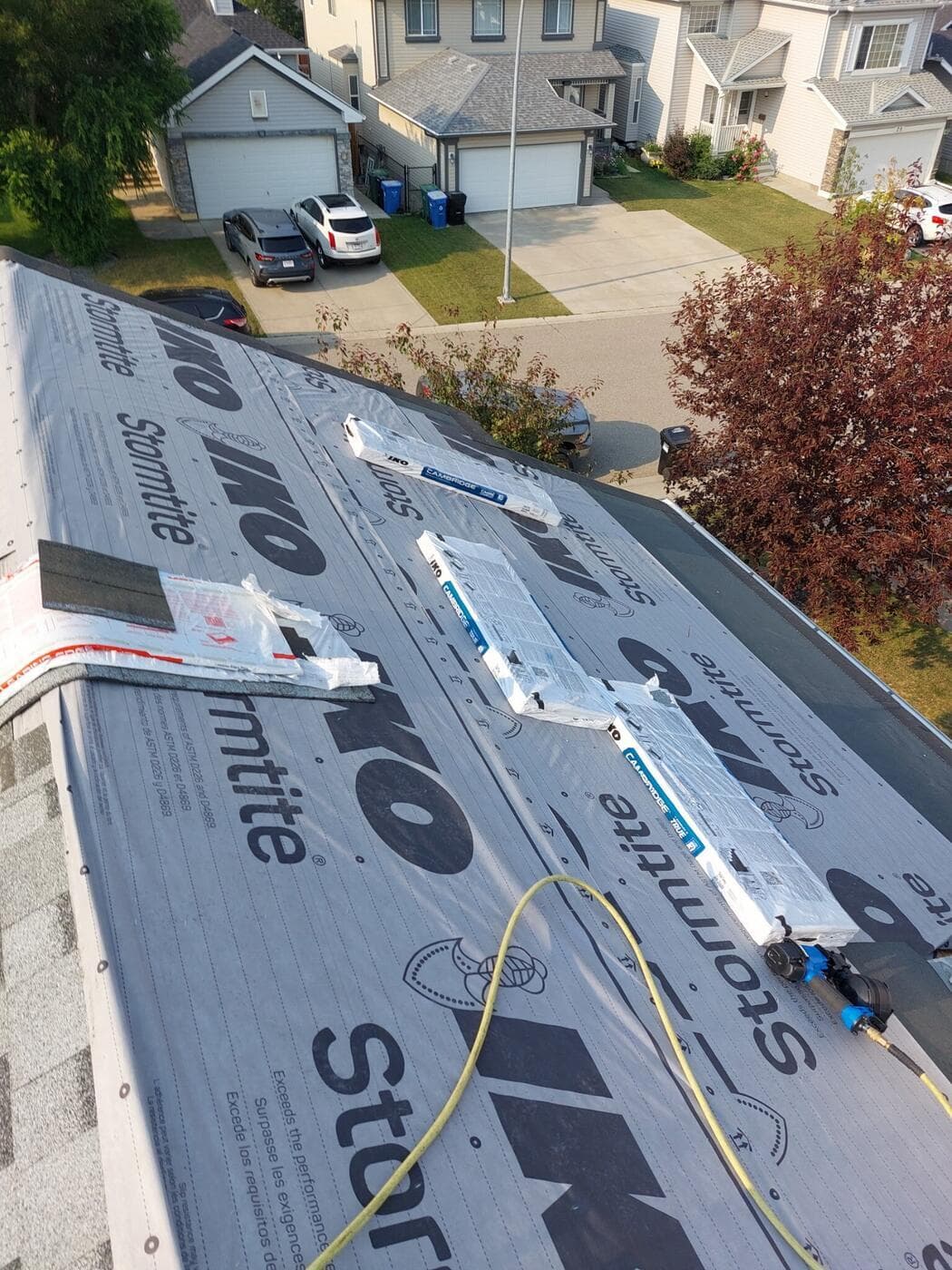
Shingles are good at shedding water that runs downhill. They're bad at stopping water that's pushed sideways by wind, backed up behind an ice dam, or channelled down a valley in a spring downpour. That's the job of the layers underneath.
This article covers those layers: the underlayment across the field of the roof, the self-adhered membrane at the eaves and valleys, and the metal drip edge at the perimeter. It also covers what Alberta's building code actually says, because this is one of the few places where the code is specific enough to check a quote against.
Underlayment: synthetic vs felt
Underlayment is the sheet rolled over the whole roof deck before the shingles go on. For decades it was asphalt-saturated felt, often called tar paper. Many crews now use synthetic underlayment, a polymer sheet.
Part 9 of the building code sets rules for underlay when it's used under shingles, including paper and felt types, a minimum 50 mm head and end lap, and a 100 mm overlap onto the eave protection. Manufacturers and trade standards go further. IKO's application instructions call for 2 inch side laps and 4 inch end laps, and note that one layer over the entire deck is needed to qualify for a Class A fire rating. The Alberta Roofing Contractors Association standard calls for the whole field of the deck to be covered, with laps of at least 100 mm.
| Synthetic | Asphalt-saturated felt | |
|---|---|---|
| Strength | IKO says Stormtite is stronger than traditional felt and designed to resist slips, tears and shredding from foot traffic | Check the product's rating |
| Water | IKO says Stormtite sheds water and acts as a vapour retarder | One of the underlay types Part 9 lists for use under shingles |
| Exposure | IKO says Stormtite can be exposed for up to 30 days and still perform | Follow the manufacturer's limit, and ask how soon it will be covered |
Ice and water shield: the self-adhered membrane
Ice and water shield is the common name for self-adhering modified bitumen membrane. It's a sticky, rubberised sheet with a peel-off backing. Once pressed down, it bonds to the deck and seals around the shanks of the nails driven through it. That's the key difference from regular underlayment: water that sits on it, like meltwater backed up behind an ice dam, doesn't find its way through the nail holes.
The code lists several acceptable eave protection materials, including two plies of cemented felt and roll roofing, but self-sealing modified bituminous membrane is a common choice today.
What Alberta's building code requires at the eaves
Alberta's code is the National Building Code – 2023 Alberta Edition, based on the National Building Code of Canada 2020. Its Part 9 update summary lists no changes to the eave protection article. The Part 9 wording, Article 9.26.5.1, as published in British Columbia's edition of the same model text, says eave protection shall be provided on shingle, shake or tile roofs, extending from the edge of the roof a minimum of 900 mm up the roof slope to a line not less than 300 mm inside the inner face of the exterior wall.
In plain terms: the membrane must run at least 3 feet up from the edge, and it must also go at least a foot past the inside of your wall. On a house with a deep overhang, the second rule is the one that decides how far up it goes. That's because ice dams form over the cold overhang and push water back up over the warm wall and ceiling.
- Not required over unheated garages, carports and porches.
- Not required where the overhang itself is more than 900 mm measured along the slope to the inside face of the wall.
- Not required on low-slope asphalt shingle roofs built to the code's low-slope rules, which have their own underlay requirements.
- Not required on roofs with slopes of 1 in 1.5 or steeper.
- Not required in regions with 3,500 or fewer degree-days, a measure of how cold the climate is.
Valleys and low-slope sections
A valley is where two roof slopes meet in a V and funnel water together. Because it concentrates the water from two slopes, it gets extra protection. IKO's instructions for an open metal valley call for a 36 inch strip of ice and water protector centred in the valley, then a metal valley liner at least 24 inches wide and at least 28 gauge. The ARCA standard also calls for at least one ply of 36 inch (914 mm) self-adhering membrane centred in the valley.
Low slopes are the other trouble spot. The code's slope table allows asphalt shingles down to 1 in 3 in a normal application and down to 1 in 6 in a low-slope application with extra underlay protection. IKO says never to install shingles below 2:12. For 2:12 to under 4:12, IKO requires either double-coverage underlayment lapped 19 inches or a full layer of ice and water protector over the deck. Below 4:12, down to 2:12, IKO limits the warranty to 12 years, prorated, material only.
Drip edge and how it laps
Drip edge is an L-shaped metal strip along the roof perimeter. It supports the shingle overhang, keeps water from curling back under the edge onto the fascia, and closes the gap where critters and wind-driven rain get in. The ARCA standard calls for drip edge along eaves and rakes, with the flange extending at least 75 mm onto the deck.
The lapping order matters because water should always flow over a joint, never into it. IKO's instructions install drip edge along the eaves first, over underlayment or directly on the deck, then eave protection over it. At the rakes, the drip edge goes on top of the underlayment. Missing or badly lapped drip edge can let water reach the fascia board behind the eavestrough. The soffit and fascia guide covers what that looks like.
Is ice and water shield required in Alberta?
Part 9 of the building code requires eave protection on shingle roofs, at least 900 mm up the slope and 300 mm past the inside face of the exterior wall, with exceptions such as unheated garages, very steep roofs and mild climates. Self-adhered membrane is the usual material.
Should ice and water shield cover the whole roof?
Usually no. It's meant for eaves, valleys, around penetrations and low-slope areas. IKO allows a full layer of ice and water protector as one option on slopes from 2:12 to under 4:12. On steeper roofs, synthetic underlayment over the field is standard.
Is synthetic underlayment better than felt?
Many crews prefer it. IKO, for example, says its Stormtite synthetic is stronger than traditional felt, resists tears from foot traffic and can be exposed for up to 30 days. Felt is one of the underlay types Part 9 lists. Ask your contractor which product they use and why.
Does drip edge go over or under the underlayment?
In IKO's instructions, drip edge at the eaves goes on first, under the eave protection. At the rakes, it goes on top of the underlayment. Always follow the shingle manufacturer's instructions for the product being used.
Where the facts on this page come from. If a source has changed since we last checked, tell us and we'll fix the page.
- Building Code, Division B, Section 9.26 Roofing (Part 9 model code wording) · Province of British Columbia
- National Building Code – 2023 Alberta Edition, Part 9 code update information · City of Lethbridge
- National Building Code – 2023 Alberta Edition · National Research Council Canada
- Steep-Slope Roofing Standards, Section 2: Asphalt Shingle Roofing · Alberta Roofing Contractors Association (ARCA)
- IKO Cambridge Shingles Application Instructions · IKO
- Stormtite Synthetic Underlayment · IKO