
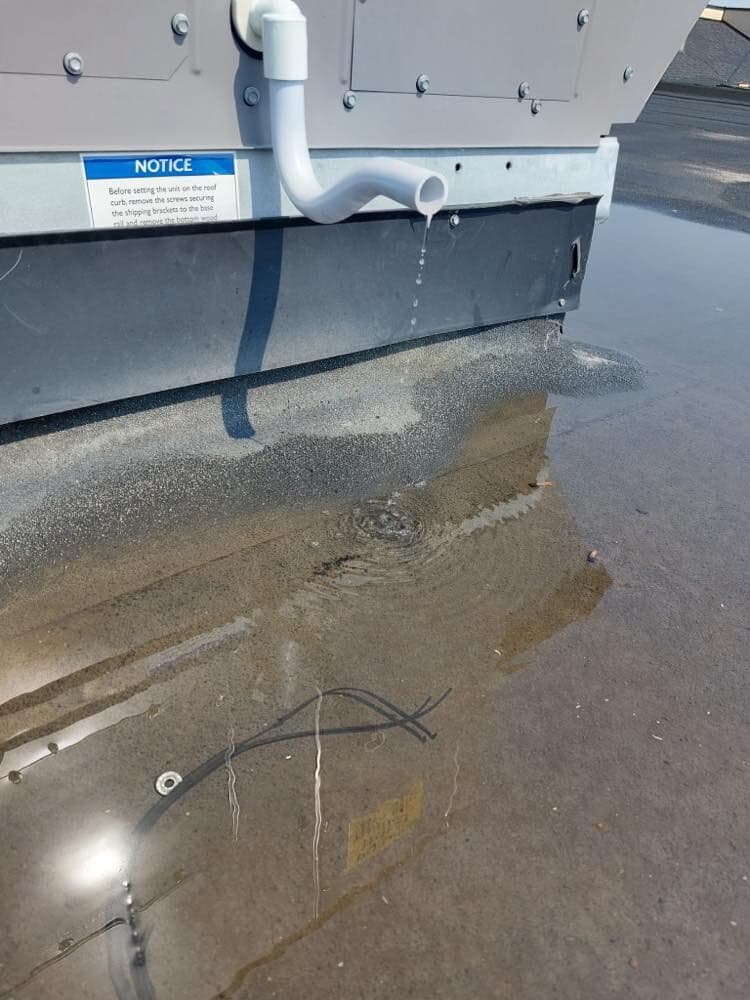
Lots of houses have a flat section somewhere: over a garage, a rear addition, a bay window or a dormer. Some infills have a flat roof over the whole house. They look simple, but they work on a completely different principle from the shingled roof on the rest of the house.
This is a primer on how low-slope roofs differ, what the membrane types are, and what keeps them working. For a detailed side-by-side of the membranes, including how each one fails in Alberta conditions, see our flat and low-slope roofing page.
What counts as flat or low slope
Roof slope is written as rise over run: a 4:12 roof rises 4 inches for every 12 inches across. The National Roofing Contractors Association (NRCA) classes roofs under 3:12 as low slope and 3:12 and up as steep slope. "Flat" roofs are almost never truly flat. They're low-slope roofs built with a slight fall so water heads to a drain or edge.
The slope decides the material. Shingles overlap and rely on gravity, so they need enough pitch for water to run off before it can work under a lap. ARCA won't issue its shingle roofing warranty certificate below 4:12. IKO limits its shingle warranty to 12 years, prorated for material only, on slopes below 4:12 and down to 2:12, and notes that some of its shingles may not be suitable below 4:12 at all.
Why low-slope roofs use membranes
On a low-slope roof, water moves slowly and sometimes sits. So instead of shedding water with overlapping pieces, the roof has to be waterproof: one continuous sheet, or several bonded layers, with every seam sealed. The weak points move from the middle of the roof to the joints: seams, the edges, drains, and anywhere the membrane turns up a wall or around a vent or skylight.
That's also why workmanship matters even more on a flat roof. A bad seam can look much like a good one on the day it's made.
The five membrane families
Membranes fall into two broad groups. Bitumen-based systems (built-up and modified bitumen) are asphalt products built up in layers. Single-ply systems (EPDM, TPO and PVC) are one factory-made sheet with sealed seams. Lifespans below are InterNACHI's published estimates, and real results depend heavily on installation and drainage. The descriptions follow IKO's guide to low-slope systems.
| System | What it is | How it goes together | Published lifespan |
|---|---|---|---|
| Built-up (BUR) | Alternating layers of asphalt and roofing felts, so one failed layer has others behind it | Layers bonded with asphalt | About 30 years |
| Modified bitumen | Asphalt modified with SBS or APP polymers, in rolls | Torched, hot-mopped, cold adhesive or self-adhered, depending on the product | About 20 years |
| EPDM | A synthetic rubber single-ply sheet | Seams bonded to the manufacturer's instructions | 15 to 25 years |
| TPO | A thermoplastic single-ply sheet | Seams welded with heat or solvent | 7 to 20 years |
| PVC | A thermoplastic single-ply sheet | Seams welded with heat or solvent | Not listed; varies by product |
Ponding water
ARMA defines ponding water as water that stays on a roof 48 hours or longer. A few puddles that dry the next afternoon are normal. Water that's still there two days later points to a drainage problem.
ARMA lists what ponding can do: the extra weight can deform the deck, ice can form and move against the membrane, algae and vegetation can grow, and debris collects and clogs the drains. It recommends a minimum slope of 1/4 inch per foot. Fixes include tapered insulation that builds slope into the roof, added drainage such as drains, scuppers and gutters, and small ridges called crickets that divert water around rooftop equipment and other obstacles.
Drainage: where the water goes
A low-slope roof drains one of three ways. Interior drains sit in the roof surface and run down through the building. Scuppers are openings through a parapet wall at the roof edge. Edge drainage runs water straight into an eavestrough.
Every one of those can clog with leaves, grit and granules washed off the shingled roof above, and a clogged drain turns a well-sloped roof into a pond. On houses where a steep roof drains onto a flat one, the landing spot takes a beating and deserves an extra look.
Maintaining a flat roof
Flat roofs reward regular attention more than shingled ones do. Twice a year, in spring and fall, and after big storms:
- Clear leaves, debris and granules from drains, scuppers and eavestroughs.
- Look for water still standing two days after rain, and note where.
- Check seams for lifting edges, gaps or open laps.
- Check where the membrane turns up walls and around vents, skylights and curbs.
- Look for blisters, splits, punctures or bare spots on the surface.
- Check the ceiling below for stains, and act early. Water travels under a membrane before it shows inside.
Can you put shingles on a flat roof?
Generally not. Shingles need slope to shed water. IKO shortens its shingle warranty below 4:12 and notes some of its shingles may not be suitable there, and ARCA won't certify a shingle roof below 4:12. A truly low-slope roof needs a membrane.
How long does a flat roof last?
InterNACHI's published estimates range from 7 to 20 years for TPO, 15 to 25 for EPDM, about 20 for modified bitumen and about 30 for built-up roofing. Drainage and seam quality move those numbers a lot.
Is some water on a flat roof normal?
Small puddles that dry within a day or two are normal. ARMA defines ponding as water that stays 48 hours or longer, and that's a sign the roof isn't draining the way it should.
Which flat roof membrane is best?
There isn't one best membrane for every roof. It depends on the roof's size, what's on it, foot traffic and budget. Our flat roofing page compares the systems in detail.
Where the facts on this page come from. If a source has changed since we last checked, tell us and we'll fix the page.
- Ponding Water Basics · Asphalt Roofing Manufacturers Association (ARMA)
- Specification Test Standard 4473 (cites NRCA slope definitions) · FM Approvals
- Types of Commercial Roofing and Flat Roof Systems Guide (manufacturer technical guide) · IKO
- InterNACHI's Standard Estimated Life Expectancy Chart for Homes · International Association of Certified Home Inspectors
- Limited Warranty Information for Asphalt Shingles (Canada) · IKO Industries
- Steep-Slope Roofing Standards, Section 2: Asphalt Shingle Roofing · Alberta Roofing Contractors Association (ARCA)