
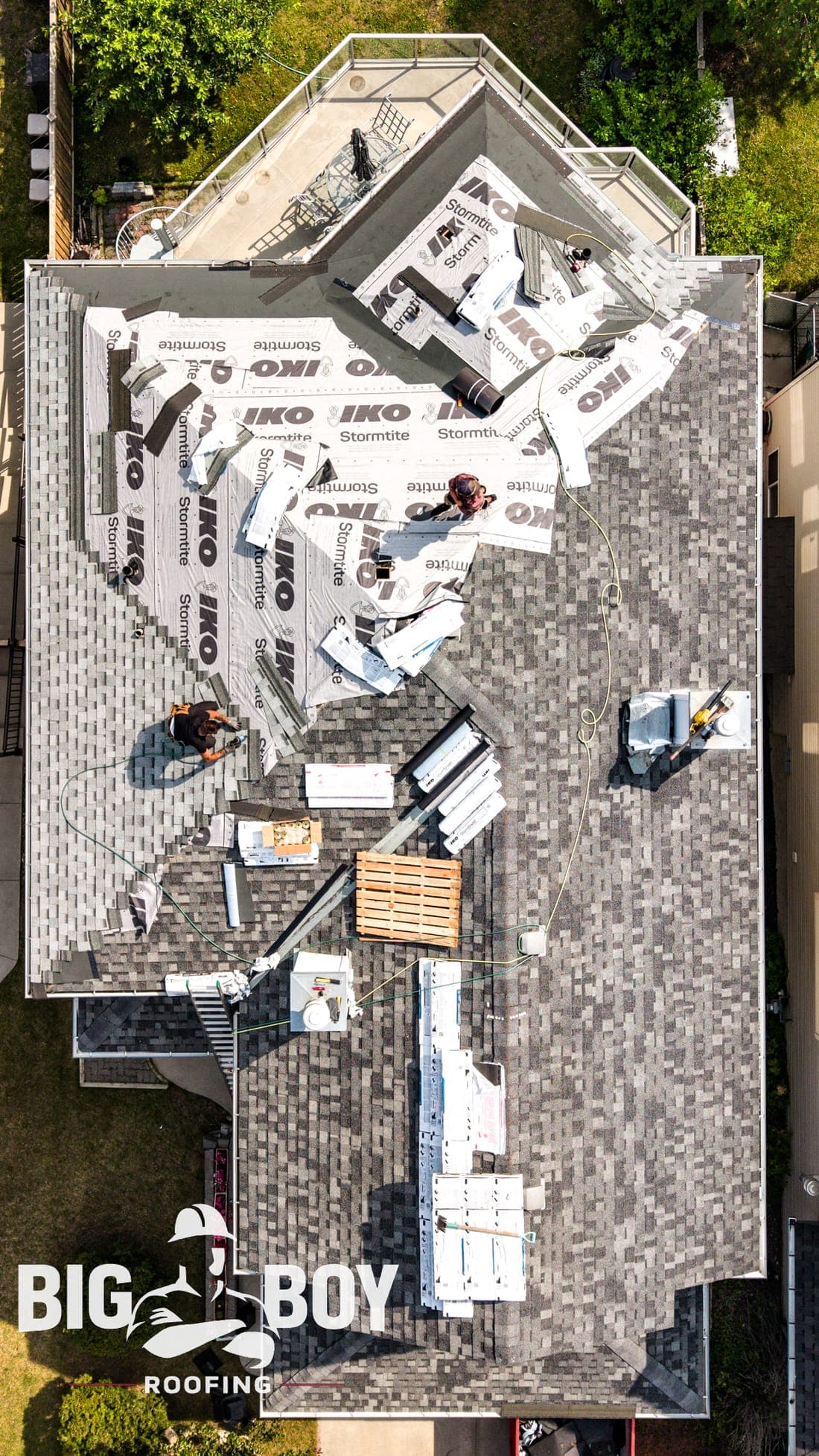
Most homeowners see a roof replacement in two snapshots: an old roof in the morning and a new one at dinner. What happens in between is a sequence, and the order matters. Every layer covers the one before it, so a shortcut early in the day gets buried by the afternoon.
This is the sequence on a typical sloped asphalt shingle roof. The details change with the house, the weather and the manufacturer's instructions, but the order doesn't change much. Knowing it lets you ask good questions before the job and spot trouble while it's still easy to fix.
Before the crew arrives: delivery and protection
Materials usually show up a day or two ahead, either stacked on your driveway or lifted straight onto the roof by the supplier's boom truck. Rooftop delivery keeps your driveway clear but puts a lot of weight in one spot, so bundles get spread along the ridge.
On day one the crew sets up before a single shingle comes off. That means a dumpster or trailer placed where it won't block anyone, tarps over plants and against walls, and plywood or boards leaned over windows and doors that face the drop zone. Ladders go up in spots that won't crush your flower beds.
Tear-off: the loud part
Tear-off is exactly what it sounds like. The crew uses roofing shovels and forks to pry up the old shingles, underlayment, nails and usually the old flashing and vents, then throws or chutes it all into the bin. On most houses they strip one section at a time, so the roof is never left wide open if the weather turns.
Inside, it sounds like someone is dragging furniture across your ceiling while dropping bowling balls. Dust and old granules can fall through gaps in the attic. Pictures on walls can shift. It's normal, and it's the worst of the noise.
- Expect heavy scraping and thumping directly overhead for several hours.
- Expect debris raining past the windows on the drop side.
- Don't expect the crew to strip the whole roof at once if rain or wind is in the forecast. Good crews open only what they can close the same day.
Deck inspection and resheathing
With the old roof off, the crew can finally see the roof deck, the plywood, OSB or boards nailed to your rafters that everything else fastens to. They walk it looking for soft spots, rot, delamination and gaps, usually around old leaks, valleys, chimneys and the lower edge where ice dams sit.
Damaged sections get cut out and replaced with new sheathing. Some older homes have plank board decks with gaps between the boards. IKO's application instructions call for plywood at least 3/8 inch thick or non-veneer panels such as OSB at least 7/16 inch thick, and say shingles on dimensional lumber or board decks aren't recommended because they can buckle, which IKO's warranty doesn't cover. That's why some jobs include a full resheet over old boards.
Building it back up, layer by layer
Now the roof goes back together from the bottom up, so every layer sheds water over the one below it. This order follows IKO's written application instructions. Part 9 of the building code, in the wording Alberta's code shares with British Columbia's published edition, requires the roofing materials it lists to be installed to the manufacturer's written instructions.
- Drip edge at the eaves. A bent metal strip along the bottom edge that kicks water out past the fascia and into the eavestrough.
- Ice and water shield at the eaves. A self-adhered rubberised membrane that seals around nails. It runs from the edge up past the inside line of your exterior wall, where ice dams do their damage.
- Valley protection. A wide strip of membrane down the centre of each valley, plus a metal liner if the valley is open.
- Underlayment over the rest of the deck. Synthetic sheets rolled out in overlapping horizontal rows up to the ridge.
- Drip edge at the rakes. On the sloped side edges, the metal goes on top of the underlayment.
- Starter strip. A row of starter shingles along the eaves and rakes, with the sealant placed next to the edge, so the first real course has something to bond to.
- Shingles. Courses run up the roof, offset so the joints don't line up, with four nails per shingle on the nail line in a standard application, or six in high-wind applications.
- Flashing. New step flashing along walls, plus flashing around chimneys, skylights and pipe boots at every penetration.
- Vents and ridge. Exhaust vents cut in, ridge vent installed if the design calls for it, and ridge cap shingles nailed over the peak.
Cleanup, magnet sweep and final walkthrough
The last hour matters as much as the first. Tarps come off, loose debris gets raked and bagged, and the eavestroughs get cleared of granules and scraps. Then someone walks the whole property with a rolling magnet to pick up roofing nails from the lawn, beds, driveway and street. One missed nail in a tire is how a neighbour remembers your roof.
Finally, walk the finished roof with the crew lead, from the ground or from the attic. Look at the edges, the flashing at walls and chimneys, the vents and the ridge. Ask what they found on the deck and what they replaced.
How long does a roof replacement take?
It depends on the size, pitch and shape of the roof, how much decking needs replacing, and the weather. Large, steep or cut-up roofs take longer. Ask your contractor for a realistic range for your roof, and what happens if weather delays the work.
Do I need to be home during the roof replacement?
Not the whole time. It helps to be around at the start to walk the setup, and at the end for the walkthrough. The crew needs outside access, a clear driveway and, if you're on the job, a way to reach you if they find damaged decking.
Can a roof be replaced in the rain or cold?
Crews generally avoid tearing off in rain and open only what they can cover the same day. In cold weather, IKO's instructions call for manual sealing when conditions might stop the sealant strips from bonding, and for storing hip and ridge shingles in a heated area so they bend more easily. Ask your contractor how they handle both.
Will my roof leak if it rains during the job?
A careful crew covers each torn-off section with eave protection or underlayment before leaving it, and tarps open areas if a storm moves in fast. Ask your contractor what their plan is for surprise weather before work starts.
Where the facts on this page come from. If a source has changed since we last checked, tell us and we'll fix the page.
- IKO Cambridge Shingles Application Instructions · IKO
- Steep-Slope Roofing Standards, Section 2: Asphalt Shingle Roofing · Alberta Roofing Contractors Association (ARCA)
- Building Code, Division B, Section 9.26 Roofing (Part 9 model code wording) · Province of British Columbia
- National Building Code – 2023 Alberta Edition · National Research Council Canada