
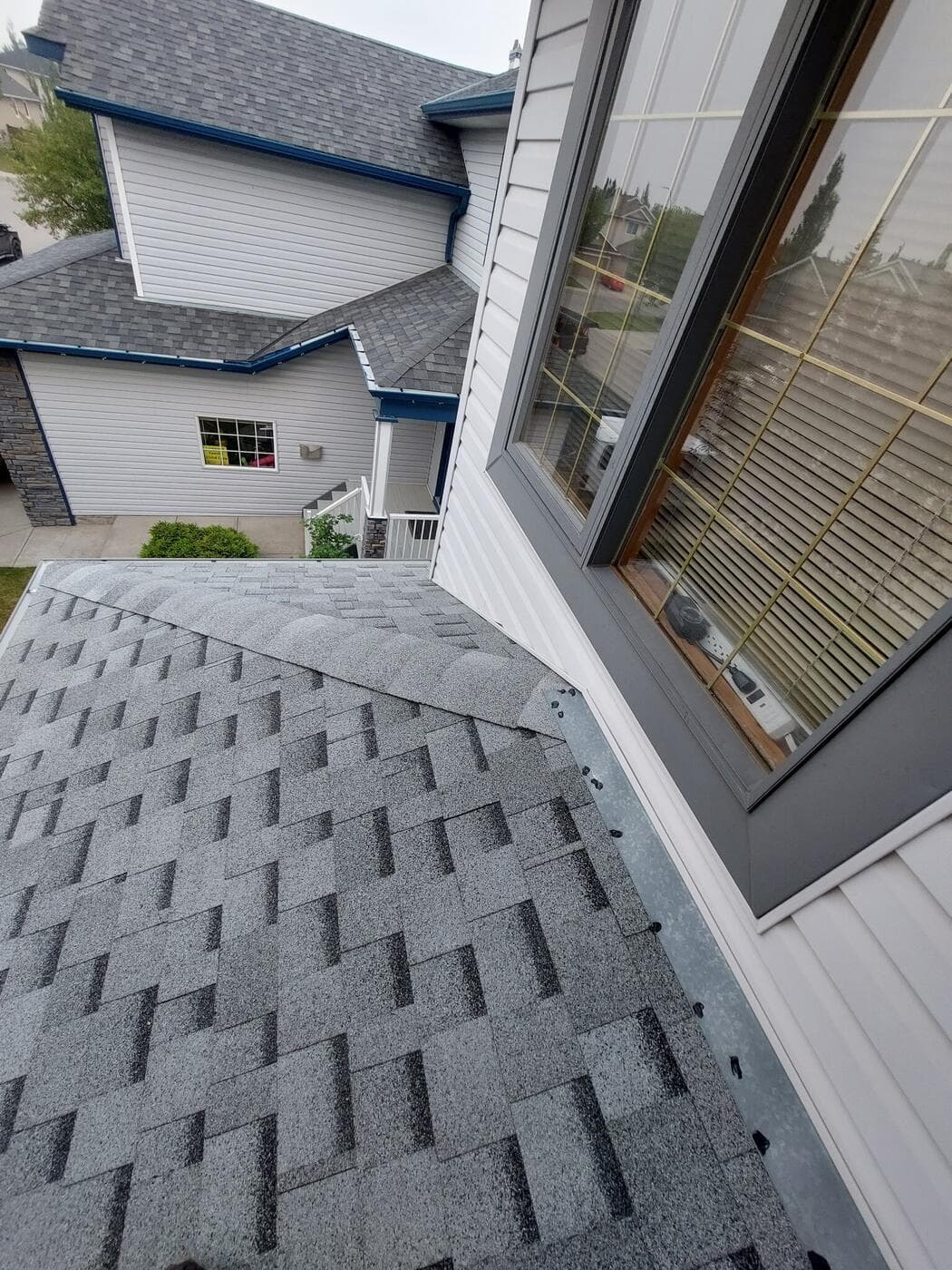
A field of shingles is easy to keep dry. Water lands on it and runs downhill, and each course laps over the one below. The trouble starts wherever that pattern is interrupted: a wall rising out of the roof, a chimney, a valley where two slopes meet, a skylight or a plumbing vent.
Those joints are what flashing is for. It's thin metal, or sometimes a membrane, shaped so water running toward the joint is turned back onto the shingles. This guide walks through each kind on a typical Calgary house, what the building code and IKO's instructions ask for, and how to tell when it's the flashing, not the shingles, that has failed.
The one rule every piece of flashing follows
Water should always run over a lap, never into one. Every piece of flashing is installed so the higher piece overlaps the lower piece, the way shingles do. When a leak traces back to flashing, the cause is usually that the order got reversed, a piece is missing, or the whole joint was left to a bead of sealant.
IKO's application instructions put it simply: corrosion-resistant flashing must be used where a roof meets a wall, another roof, a chimney or other objects that penetrate the roof, and it must follow the building code and good roofing practice.
Step flashing and counterflashing along walls
Where a sloped roof runs up beside a wall, like the side of a dormer or a second storey, the joint gets step flashing. These are individual L-shaped pieces. One leg lies on the roof and the other turns up the wall. A new piece goes in with each course of shingles, so the pieces overlap down the slope like stairs.
The Alberta Roofing Contractors Association (ARCA) standard calls for sheet metal step flashing wherever the rake of a roof abuts a vertical wall. Part 9 of the building code sets the minimums for walls clad in something other than masonry, such as vinyl siding or stucco:
- The flashing extends at least 75 mm up the wall, behind the sheathing paper.
- It extends at least 75 mm horizontally onto the roof.
- Along the slope, it's stepped with at least a 75 mm head lap.
Headwall flashing where a slope runs into a wall
When the top edge of a slope meets a wall, for example a porch roof running into the front of the house, the joint is horizontal rather than stepped. It gets one continuous piece, often called headwall or apron flashing, laid over the top course of shingles and turned up the wall. The same principle applies: the wall's weather barrier and siding lap down over the vertical leg, so water coming down the wall lands on the metal and runs out onto the shingles.
Chimneys: counterflashing and saddles
A chimney gets water from every direction, including a lot of it from the slope above. Part 9 of the code treats masonry chimneys and walls with extra care:
- Counterflashing is embedded at least 25 mm into the masonry, extends at least 150 mm down the masonry and laps the lower flashing by at least 100 mm.
- Flashing along the sides of the chimney is stepped with at least a 75 mm head lap in both the lower flashing and the counterflashing.
- Where the roof slopes up from the chimney, flashing extends up the slope to a height equal to the flashing on the chimney, and at least 1.5 times the shingle exposure.
- A chimney saddle (also called a cricket) is required where the upper side of the chimney is more than 750 mm wide. The saddle is a small peaked roof behind the chimney that splits the water and sends it around both sides.
Valleys: open metal versus closed
A valley is where two slopes meet in a V and carry both slopes' water down one channel. The code requires every valley on a shingled roof to be flashed, over continuous sheathing. An open valley flashed with sheet metal needs a sheet at least 600 mm wide.
IKO's instructions for its Cambridge shingles recommend open metal valleys and describe closed valleys as acceptable but not recommended. For an open valley, IKO calls for a 36 inch strip of ice and water protector centred in the valley, then a metal liner at least 24 inches wide and at least 28 gauge. The shingles are trimmed back along chalk lines, the corners are clipped so water is directed into the valley, and no nail goes within 2 inches of the chalk line. ARCA's standard likewise calls for a ply of 914 mm self-adhering membrane centred in the valley and requires open valleys with laminated shingles.
| Type | What you see | Notes |
|---|---|---|
| Open metal | A strip of exposed metal down the V | IKO's recommended method. The metal carries the water. |
| Closed cut | Shingles from one slope run across the valley and the other slope is cut in a straight line | IKO: acceptable but not recommended. Check the shingle's instructions and warranty. |
| Woven | Shingles from both slopes interlace across the valley | Often not suited to thick laminated shingles. Follow the manufacturer. |
Pipes, vents and skylights
Anything that goes through the roof is a hole that has to be sealed:
- Plumbing vent pipes get a flashing boot: a metal or plastic base with a rubber collar that hugs the pipe. The shingles above lap over the base, and the base laps over the shingles below. The rubber collar often wears out before the shingles around it.
- Box vents and exhaust caps have their own base flange, woven in the same way.
- Skylights are flashed with a kit designed for that unit. Follow the skylight maker's instructions, because the kit and the frame are designed to work together.
How flashing fails, and what you'd notice
Flashing rarely fails all at once. It's usually a slow leak that shows up as a stain some distance from the source, because water runs along the decking before it drips. Finding a roof leak explains how to trace one.
| Problem | Where | What you might notice |
|---|---|---|
| Cracked or missing sealant carrying the joint | Chimneys, walls, vents | Stains near the chimney or on the wall below a roof line |
| Step flashing missing, or sitting on top of the wall barrier | Sloped walls, dormers | Stains or rot on the wall under a roof edge |
| No saddle on a wide chimney | Upslope side of the chimney | Ice and water pooling behind the chimney, attic stains near it |
| Worn rubber collar on a pipe boot | Plumbing vents | A drip or stain directly around a vent pipe in the attic |
| Rusted or dented metal | Valleys, vents, counterflashing | Rust streaks, visible holes, dented metal after hail |
Flashing in a replacement quote
Nobody can see the condition of step flashing and counterflashing until the shingles around them come off. A clear quote says how flashing will be handled so there's no surprise on tear-off day. Questions worth asking:
- Will step flashing, headwall flashing and pipe boots be replaced, or reused, and what decides that?
- How will the chimney be flashed and counterflashed, and does it need a saddle?
- Which valley method will you use, and is it the one the shingle manufacturer recommends?
- Where does ice and water membrane go besides the eaves: valleys, around the chimney, at skylights?
What is roof flashing?
Thin metal, or sometimes membrane, installed where the roof meets something else: a wall, a chimney, another slope in a valley, or a pipe or skylight coming through. It's lapped so water running toward the joint is turned back onto the shingles.
What's the difference between step flashing and counterflashing?
Step flashing is a series of L-shaped pieces woven in with each shingle course where a sloped roof meets a wall. Counterflashing comes down from the wall or chimney and laps over the top of it, so water can't run in behind. On masonry, Part 9 of the code requires counterflashing embedded at least 25 mm into the masonry.
Does a chimney need a cricket?
Under Part 9 of the building code, a chimney saddle (cricket) is required where the upper side of a chimney on a sloping roof is more than 750 mm wide, unless the chimney is protected by flashing that meets the code's alternative height rules.
Should flashing be replaced with a new roof?
It depends on its condition, and nobody can judge that until the old shingles are off. Ask your contractor before you sign how they'll decide, and get the answer in the quote.
Is an open or closed valley better?
IKO recommends open metal valleys for its Cambridge shingles and calls closed valleys acceptable but not recommended, and ARCA's standard requires open valleys with laminated shingles. Always follow the instructions for the shingle being installed.
Where the facts on this page come from. If a source has changed since we last checked, tell us and we'll fix the page.
- Building Code, Division B, Section 9.26 Roofing (Part 9 model code wording) · Province of British Columbia
- National Building Code – 2023 Alberta Edition · National Research Council Canada
- Steep-Slope Roofing Standards, Section 2: Asphalt Shingle Roofing · Alberta Roofing Contractors Association (ARCA)
- IKO Cambridge Shingles Application Instructions · IKO