
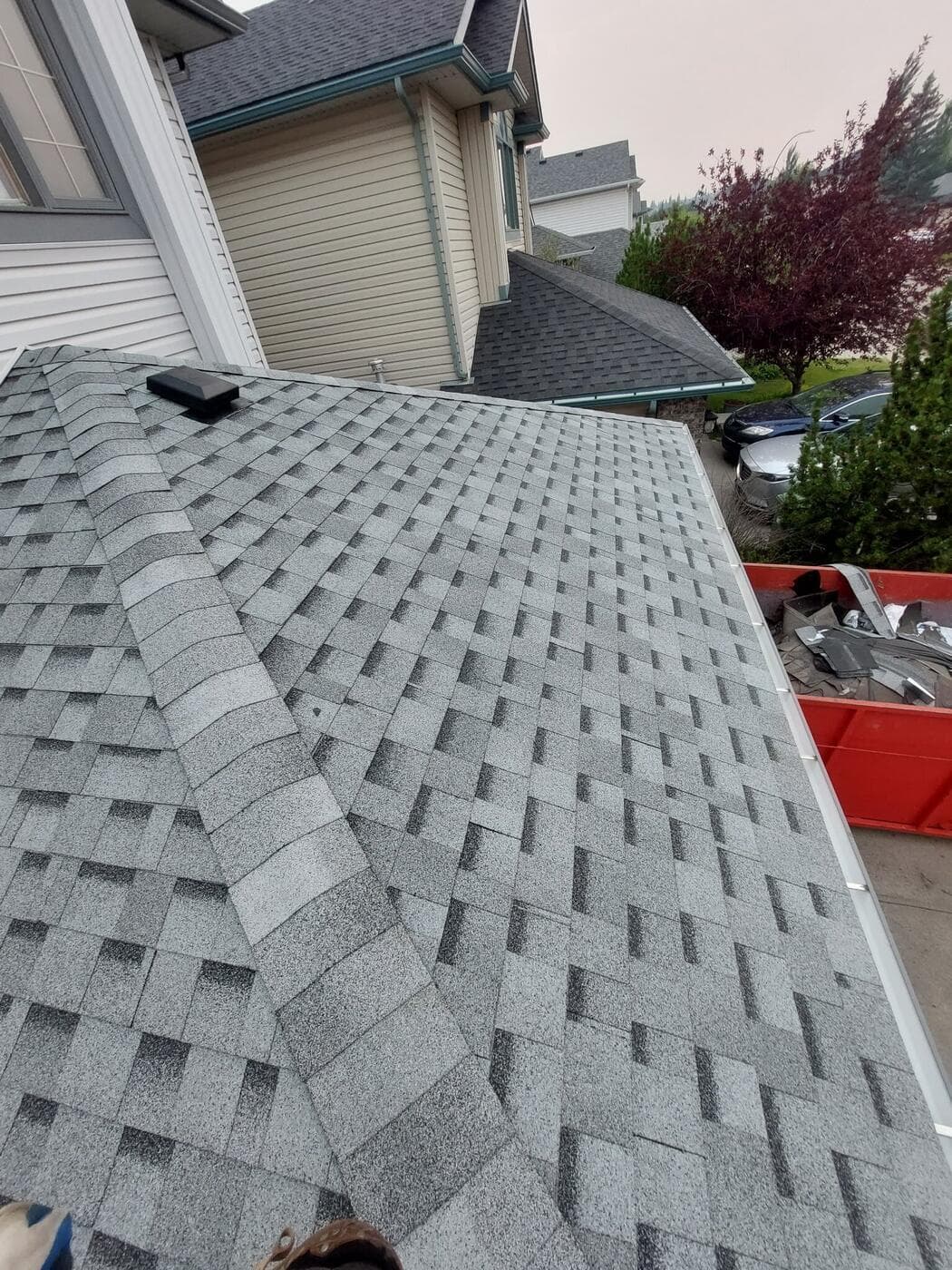
A roofing quote looks like a price with some words above it. It's actually a list of decisions about your roof: what comes off, what goes on, what gets replaced and what gets reused. Two quotes with the same total can describe very different roofs, and two quotes thousands of dollars apart can be closer than they look.
The Government of Alberta's advice on hiring a contractor says a written estimate should include a complete description of the work, the type and quality of materials, itemized costs and the total price. That's the standard to hold a quote to. This article walks through each line you should expect on an asphalt shingle replacement, what it should say, and what a vague version usually means.
If you want to know what drives the price of a roof replacement, read what a roof replacement costs in Calgary. This one is about reading the paper.
What a good quote looks like before you read a word
Start with the shape of the document. A quote you can actually compare does three things.
It's itemized. Each part of the job is its own line, even if the prices aren't broken out one by one. A single sentence like "remove and replace roof" with a number beside it tells you almost nothing about what you're buying.
It names things. Products have a brand and a line name, and coverage has a location. "Ice and water shield at eaves and valleys" is a decision. "Underlayment as required" is a placeholder.
It says what isn't included. Every quote has limits. The honest ones write them down, so you aren't discovering them on the final invoice.
The line items, and what each one should say
Here's a typical replacement quote broken into its parts. Not every roof needs every line, but every line should at least have been considered. If one is missing, ask whether it was left out on purpose or forgotten. The trickier lines get more detail below the table.
| Line item | What it should say | Red flag |
|---|---|---|
| Tear-off and layers | Full removal down to the deck, with the number of existing layers noted. | No mention of tear-off, or new shingles going over the old ones without saying so. |
| Disposal | Bin or haul-away and dump fees included. | Disposal listed as extra with no amount, or not mentioned. |
| Decking or sheathing | What's assumed about the deck, plus a per-sheet price for replacing damaged sheets. | No per-sheet rate, or "rot extra" with no number. |
| Underlayment | Product type (synthetic or felt) covering the whole deck. | "Underlayment as needed." |
| Ice and water shield | Where it goes: eaves, valleys, around penetrations, and how far up from the eave. | No locations, or eaves only on a roof with valleys. |
| Drip edge | New metal drip edge at eaves and rakes. | Not listed, or existing drip edge reused without comment. |
| Flashing | Each area (chimney, walls, skylights, valleys) marked new or reused. | "Flashing as required" with no new-or-reused decision. |
| Pipe boots | New boots on every plumbing vent, with a count. | Not mentioned, or fresh caulking around the old ones. |
| Ventilation | Existing intake and exhaust checked, with vents added or replaced listed. | Nothing about ventilation at all. |
| Ridge cap | Hip and ridge product named, from the same maker as the shingles. | Unnamed, or cut-up field shingles. |
| Starter strip | Starter at the eaves and rakes, product named. | Not listed. |
| Shingle line and colour | Brand, product line and colour, written out. | "Architectural shingle, colour TBD" with no line named. |
| Nails and fasteners | Roofing nails, and whether the pattern is standard or high-wind. | Staples, or nothing said. |
| Permits | Who's responsible for any required permit. | Silence. |
| Cleanup | Debris removal and a magnet sweep of the yard for nails. | "Site left clean" with nothing about lawns, beds or the driveway. |
| Warranty | Workmanship warranty length from the contractor, and the manufacturer warranty named separately. | One blended "lifetime warranty" with no split. |
| Payment schedule | Deposit if any, progress payments and the final payment, with what triggers each. | Full payment before work starts. |
| Exclusions | A plain list of what isn't included. | No exclusions section at all. |
Decking, allowances and the per-sheet rate
The deck, also called sheathing, is the layer of plywood or OSB under the shingles. Nobody can see its full condition until the old roof is off, which is why decking is the line most likely to change the price.
There are two honest ways to handle it. One is an allowance: the quote includes a set number of sheets, and anything beyond that is charged at a stated rate. The other is a per-sheet change-order rate with no sheets included. Either works, as long as the rate is written on the quote before you sign. What you don't want is a blank, because a blank gets filled in while your roof is open and you have no leverage.
Older houses add a wrinkle. Some were built with plank or board decking. IKO's Cambridge installation instructions say installing shingles on board decks isn't recommended because it may cause buckling, and that buckling isn't covered by its limited warranty. If your house has plank decking, a good quote says so and prices the fix.
Underlayment, ice and water shield, flashing and the rest
These lines are where roofs quietly differ. Almost all of them are hidden once the shingles are on, so a thin quote can skimp here without you noticing for years.
- Underlayment. A water-resistant layer over the deck, under the shingles. IKO's instructions note that one layer over the entire deck is needed for its shingles to qualify for a Class A fire rating, or where the local building code requires it.
- Ice and water shield. A self-sticking membrane for the places where ice and water back up. IKO's Cambridge instructions call for eave protection, as the building code and manufacturer require, that extends up the roof at least 24 inches past the inside face of the exterior wall, and a 36-inch strip of ice and water protector down the centre of open metal valleys. A quote should say where it goes. More in underlayment and ice and water shield.
- Drip edge. The metal edge that carries water off the deck and into the eavestrough. It's an inexpensive part and it should be new.
- Flashing. Metal that seals the joints where the roof meets a wall, a chimney or a skylight. Reused flashing isn't automatically wrong, but it should be a decision written on the quote, not a default.
- Pipe boots. The collars around plumbing vents. Their rubber seals age and crack, so replacing them during a re-roof is normal.
- Ventilation. IKO's Canadian warranty excludes damage caused by inadequate ventilation, including blocked vents, and says ventilation should be distributed evenly between the eaves and the rooftop. A quote that says nothing about ventilation hasn't looked. See attic ventilation explained.
- Ridge cap and starter. IKO's Canadian limited warranty lists the IKO hip and ridge products (or IKO-approved equivalents) to use with its shingles, and its Cambridge instructions require starter strip at all eaves and rakes for the high-wind warranty. Small lines, real warranty consequences.
- Nails. IKO specifies corrosion-resistant 11- or 12-gauge roofing nails with heads at least 3/8 inch across, four per shingle for standard application and six for high-wind areas or slopes of 21:12 or more, and IKO requires manual sealing in addition to six nails in Canada. Its wind warranty requires roofing nails, not staples.
Warranty, permits, payment schedule and exclusions
Warranty. A new roof comes with two warranties, and they cover different things. The workmanship warranty comes from your contractor and covers the installation. The manufacturer warranty comes from the shingle maker and covers the product. IKO's Canadian limited warranty, for example, covers manufacturing defects that significantly affect how the shingles shed water, and it specifically excludes damage from improper application. So a leak caused by poor installation is the contractor's problem, not the manufacturer's. A quote should state both warranties separately, with the length of each.
Permits. Alberta's guidance says the homeowner is ultimately responsible for making sure necessary permits are in place before work starts. That's a good reason to want the quote to say who's pulling them. What Calgary requires is covered in permits for roofing and siding in Calgary.
Payment schedule. The quote or contract should show when money changes hands and what triggers each payment. In Alberta, a business that sells away from its own premises, such as at your home, and takes payment before the work is finished needs a prepaid contracting licence. The detail is in Alberta's prepaid contractor licence.
Exclusions. Look for a plain list: things like interior damage from earlier leaks, eavestroughs, skylight replacement or structural repairs to rafters. A specific exclusions list is a sign the contractor actually thought about your roof.
How to compare two quotes fairly
Comparing totals is the fastest way to pick the wrong quote. A big gap between two quotes is often a difference in scope. The Better Business Bureau makes the same point from the other side: the lowest bid isn't necessarily the best one. Here's how to line quotes up properly.
- Make a simple grid with one row for every line in the table above and one column per quote.
- Mark each line as included, excluded or unclear. Treat unclear as excluded until the contractor answers in writing.
- Check that the quotes are for the same shingle line, or at least the same tier. An impact-rated roof against a standard one isn't a fair comparison.
- Compare the decking terms: how many sheets are included, and the per-sheet rate after that.
- Compare warranties like for like: workmanship against workmanship, manufacturer against manufacturer.
- Ask each contractor to fill their gaps in writing, then compare the adjusted totals.
What should a roofing quote include?
The scope of work line by line, the shingle brand, line and colour, what happens to decking and flashing, cleanup, the workmanship and manufacturer warranties stated separately, the payment schedule, and what's excluded. Alberta's consumer guidance says a written estimate should describe the work and materials, itemize costs and give the total price.
Is it normal for a roofing quote to change after the old roof comes off?
The decking line can change, because nobody sees the whole deck until tear-off. That part is normal. What isn't normal is a change with no rate agreed in advance. The per-sheet price should already be on the quote, and extra work should be approved by you in writing before it's done.
Why are two roofing quotes for the same house so different?
Usually because they describe different roofs. One may include new flashing, ice and water shield in the valleys and a decking rate, and the other may not. Line them up item by item before you compare the totals.
Does the shingle manufacturer's warranty cover installation mistakes?
Generally, no. Manufacturer warranties cover product defects. IKO's Canadian limited warranty, for example, excludes damage from improper application. Installation problems fall under the contractor's workmanship warranty, which is why both belong on the quote.
Should I pay a deposit when I accept a roofing quote?
Some contractors ask for one on a replacement and some don't. Either way, get the payment schedule in writing. In Alberta, a contractor who sells to you at your home and takes money before the work is finished needs a prepaid contracting licence, which you can check yourself. See Alberta's prepaid contractor licence.
Where the facts on this page come from. If a source has changed since we last checked, tell us and we'll fix the page.
- Hiring a contractor · Government of Alberta
- IKO Cambridge Shingles Application Instructions · IKO
- Limited Warranty Information for Asphalt Shingles (Canada) · IKO
- Prepaid contracting licence · Government of Alberta
- How to hire a reliable and trustworthy general contractor · Better Business Bureau