
JULY 25, 2026EDMONTON WINDSTORM
Edmonton, with power outages mostly in the west end and north of downtown
What happened on July 25, 2026
On the night of Saturday, July 25, 2026, a thunderstorm crossed Edmonton with heavy rain and strong wind. Environment Canada issued its first warning for the city around 9 p.m., Blatchford recorded nearly 30 mm of rain in an hour, and Environment Canada recorded a maximum gust of 94 km/h. Around 37,700 Epcor customers lost power, mostly in the west end and north of downtown.
Environment Canada reported flooded major roadways, sewer backups and numerous downed trees. Whitemud Drive was closed by flooding between 156 Street and 178 Street, and bricks blown off an apartment wall damaged a vehicle. The storm also cancelled a concert at Commonwealth Stadium, where people in the crowd described hail.
It came at the end of a record-wet summer: Environment Canada said Edmonton had 503.7 mm of rain that summer, against a previous record of 417.1 mm set in 1953. No insured-loss figure has been published for this storm on its own.
July 25, 2026, in figures.
- Edmonton, with power outages mostly in the west end and north of downtown[2]
- Saturday night. Environment Canada's first warning for the city went out around 9 p.m.[1]
- Nearly 30 mm between 9 and 10 p.m. at Blatchford[1]
- A maximum gust of 94 km/h recorded by Environment Canada[2]
- Around 37,700 Epcor customers without power[2]
- [1]CBC News, July 26, 2026: Thunderstorm floods roads, knocks out power in Edmonton
- [2]CBC News, July 27, 2026: Storm damage, power outages and the record rainfall total
- [3]Global News, July 26, 2026: Whitemud Drive closed by flooding
Every figure on this page comes from the published sources above, not from us. Last checked against them on October 11, 2026. Insured-loss estimates are revised after a storm, sometimes for years, so treat any figure as an estimate.
What it means for your roof today
A shingle that lost its seal in a gust can lie flat for months and then go in the next strong wind, so a roof can look fine and still be loose. If you were in the area on July 25, 2026 and nobody has looked at your roof since, have it checked and keep the date with your notes.
In Alberta, the statutory conditions in a home policy require prompt written notice of a loss, and a court action over a property claim generally has to start within 2 years of when you knew or ought to have known about the damage. Your policy may set other time limits, such as a deadline to claim depreciation. That's general information, not legal advice: your policy wording governs, and your insurer or a lawyer can tell you where you stand.
Check your hail or wind deductible on your declarations page before you file. Filing is your decision. We inspect, photograph every slope and write the damage up against the storm date; you and your insurer handle the claim.
Signs of wind damage
Wind rarely takes a roof off in one piece. It lifts, creases and unseals shingles, and the edges go first:
- Missing tabs or whole shingles, often at the eaves, rakes, ridges and hips.
- Creased shingles: a line across the top where a shingle lifted and folded back.
- Lifted edges that no longer sit flat, easiest to see in low morning or evening light.
- Gouges and tears from branches or flying debris.
- Bent eavestrough, loose flashing and damaged siding on the windward side.
Look from the ground, not from a ladder. What it looks like in photos is on our hail damage guide.
STRAIGHT ANSWERS.
Is it too late to claim damage from the July 25, 2026 storm?
It depends on your policy and on when you found the damage. Alberta's statutory conditions require prompt written notice of a loss, and a court action over a property claim generally has to start within 2 years of when you knew or ought to have known about the damage. If you've only just found damage from this storm, report it now and ask your insurer what it needs. This is general information, not legal advice.
How do I show the damage came from this storm and not from age?
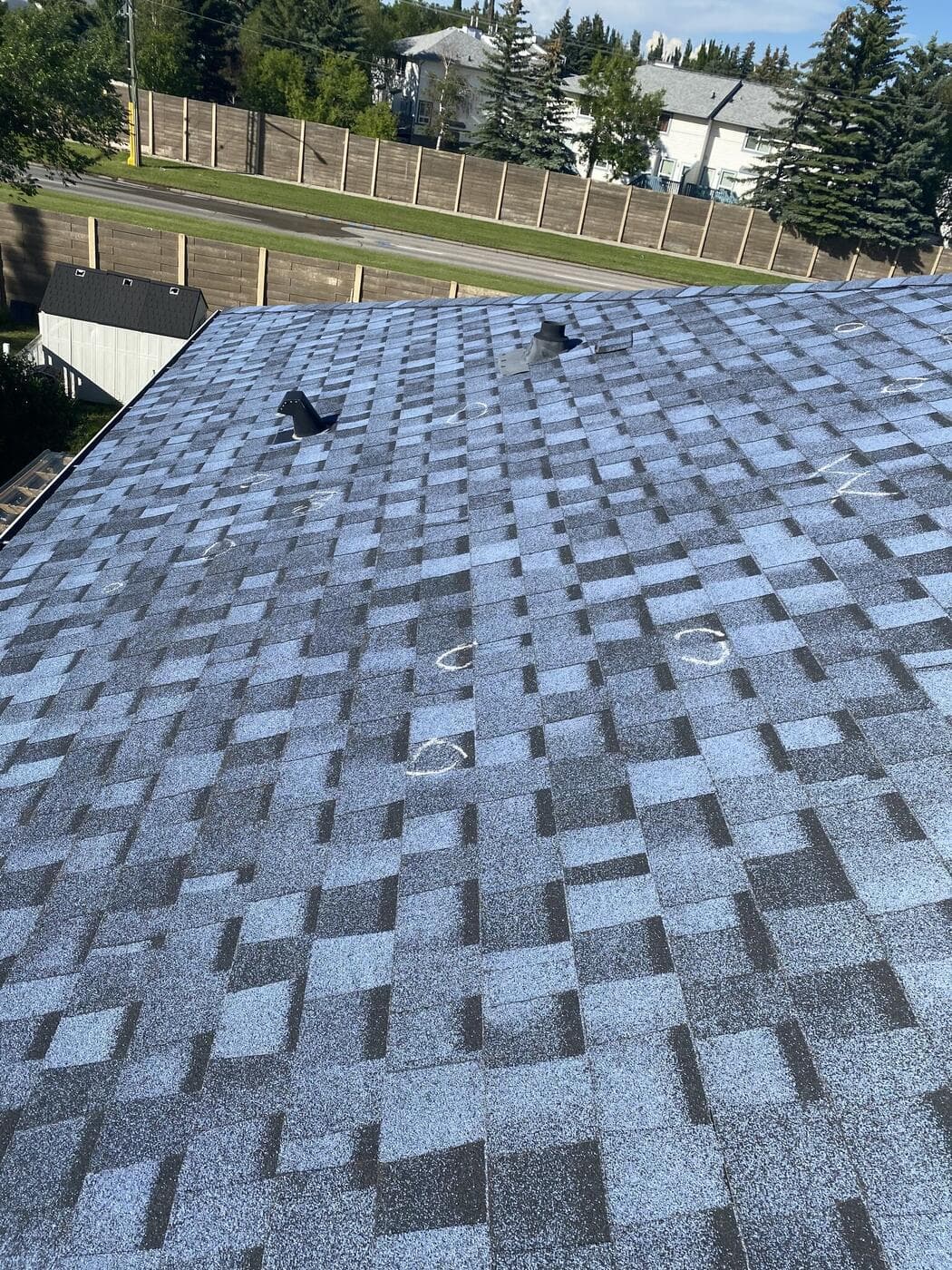
Hail leaves a recognisable pattern: random impacts, granule loss at the strike points and bruising you can feel, plus dents on the soft metals, which reads differently from even weathering. A report that photographs that pattern slope by slope, with scale references, and reasons from it to a dated storm is what ties damage to a date of loss. An assertion without that reasoning is not documentation.
My roof was replaced after this storm. Should I still get it looked at?
It can be worth it. Vents, flashing, skylights, eavestrough and siding take hail on their own, and they can be left out of a roof-only scope. If anything on the house wasn't replaced, it's worth a look.
WAS YOUR ROOFIN ONE OF THESE?
Tell us the storm date and your address. We'll document what's actually on the roof.