Nobody wants to spend replacement money on a roof that has years left. Nobody wants to pay for three repairs on a roof that was finished two repairs ago, either. Both mistakes are common, and both come from making the call on a single fact, usually the age of the roof or the size of the stain on the ceiling.
The better approach is to ask whether the failure is isolated or systemic. An isolated failure has one cause in one place: a cracked pipe boot, flashing that let go at a wall, a few tabs torn off in a windstorm. A systemic failure is the whole roof wearing out, or damage spread across every slope. The questions below help you sort one from the other.
The decision at a glance
No single row decides it. If most of your answers land in one column, that's your answer. If they split, the deciding factors are usually the decking and whether the shingles are still flexible.
| Factor | Leans repair | Leans replace |
|---|---|---|
| Age | Well within the expected range for the material | Near or past the published range, around 20 years or more for asphalt |
| How widespread | One area, one slope or one detail | Damage or wear across several slopes |
| Leaks | One leak with a clear cause, like flashing or a vent boot | Repeat leaks in different places |
| Shingle condition | Flexible, granules mostly intact | Brittle, cracking, curling, bare patches |
| Decking | Solid, with no soft spots | Soft, delaminated or rotted in multiple areas |
| Layers | One layer | Two layers already on the roof |
| Cause | Wear at a detail, or a one-off event | Hail across the roof (check your insurance first) |
| Matching | Current product, or a slope nobody sees | Discontinued shingle on a front-facing slope |
Age tells you where to look. Condition decides.
InterNACHI's chart puts asphalt shingles at roughly 20 to 30 years, but it also says weather, design, material quality and maintenance change that, so age alone is a poor trigger. A well-ventilated roof that has never seen big hail can outlast a younger one that has.
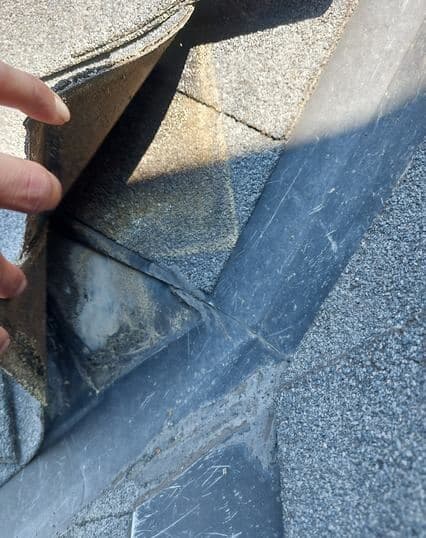
The practical test is flexibility. When a roofer lifts a tab to replace a shingle, a healthy shingle bends. InterNACHI notes that when shingles are old and brittle it may be impossible to re-fasten them without damaging them. If the shingles around a repair crack when they're lifted, each repair can damage the roof around it. Combine that with granule loss across whole slopes and replacement is usually worth pricing.
Decking and layers
The Asphalt Roofing Manufacturers Association (ARMA) says replacement may not be necessary when the roof has a single layer of shingles that lies flat and the deck is in good condition. It points to tearing off when:
- There are already two layers. ARMA notes most building codes don't allow more than two layers.
- The roof deck is damaged, sagging, or has large gaps (more than 1/4") between deck boards.
- The existing shingles are too curled or distorted to give the new ones a flat base.
- The structure can't carry the weight of another layer.
The matching problem
Even a well-done repair can stick out. Shingle colours are blends that fade with years of UV, and manufacturers retire colours and whole product lines. IKO's warranty states that it can discontinue or modify products without notice, and that colour or shading variation between shingles isn't covered.
For a leak on a back slope, a slightly different shade is a fair trade for a sound roof. For hail or wind damage on the front of the house, a patchwork repair can change how the house looks. If the right shingle isn't made any more, get the mismatch in writing before any work starts so nobody is surprised.
When insurance is part of the picture
If the damage came from a storm, call your insurer before you decide anything. Manufacturer warranties cover defects, not weather. IKO's excludes hail outright, so storm damage is a home insurance question.
Whether a claim leads to a repair or a full replacement depends on your policy wording, your deductible and what the adjuster finds. If a repair costs less than your deductible, a claim won't pay anything toward it. Hail across every slope is a different conversation. Our step-by-step claim guide and the explainer on how adjusters assess hail cover what happens next.
Getting a straight answer
A useful roof assessment gives you photographs of the actual problem, a stated cause, and an opinion on repair versus replacement with reasons you can check against the table above. Be wary of any assessment that jumps to replacement without showing you widespread damage, and equally wary of a repair quote that won't mention the shingles are brittle.
- Look at the roof from the ground and in the attic, and note stains, daylight, frost or soft spots.
- Get a hands-on inspection with photos of every slope and every leak area.
- Ask whether the problem is isolated or systemic, and why.
- If it's storm damage, talk to your insurer before signing anything.
- For a repair, ask whether the new shingles will match. For a replacement, ask how decking will be handled and priced.
Can I put new shingles over my old ones?
Sometimes, but it's often a poor trade. ARMA says it's only an option over a single flat layer on a sound deck, and that most codes don't allow more than two layers. You also lose the chance to inspect and repair the deck and replace old flashing.
Is it worth repairing a 20-year-old roof?
If the problem is isolated and the shingles are still flexible with good granule coverage, it often is. If shingles crack when lifted or the wear is across whole slopes, more repairs are likely, and it's worth pricing a replacement alongside the repair.
Can I replace just one side of my roof?
It's possible, and it can make sense when damage really is limited to one slope. The catches are matching, since the new shingles will look different from aged ones, and the ridge and hips where the two sections meet.
How do I know if my roof decking is bad?
From the attic, look for dark staining, delaminating plywood, sagging between rafters or daylight around nails. On the roof, soft or spongy spots underfoot are a warning. The full picture only comes at tear-off, which is why a contract should say how replacement decking is priced.
Will insurance replace my whole roof if only part is damaged?
It depends on your policy wording and the adjuster's assessment. Some claims cover a partial repair and some cover full replacement. Read your policy and ask your insurer directly. Our guide to ACV and RCV explains how payouts are commonly calculated.
Where the facts on this page come from. If a source has changed since we last checked, tell us and we'll fix the page.
- Asphalt Shingle Reroofing: Replacement vs. Recover · Asphalt Roofing Manufacturers Association (ARMA)
- Limited Warranty Information for Asphalt Shingles (Canada) · IKO Industries
- InterNACHI's Standard Estimated Life Expectancy Chart for Homes · International Association of Certified Home Inspectors
- Inspecting Asphalt Shingle Roofs: Student Book · International Association of Certified Home Inspectors