
AUGUST 5, 2024CALGARY HAILSTORM
Northern Calgary and Strathmore
- INSURED LOSS
- $3.35 BILLION
- CLAIMS
- MORE THAN 130,000
- HAIL
- UP TO HEN-EGG SIZE IN NORTHEAST CALGARY
What happened on August 5, 2024
On the evening of August 5, 2024, a rotating thunderstorm that formed in the foothills crossed northern Calgary between about 7:45 and 8:30 p.m., then the northeast and the airport, with hail up to hen-egg size. CatIQ's final estimate is $3.349 billion in insured damage from more than 130,000 claims: the costliest hailstorm in Canadian history.
Environment Canada describes two rotating storms erupting along the southern Alberta foothills that evening. One hit Calgary's northern suburbs and then the northeast quadrant before crossing the airport, where icy stormwater poured through a terminal roof. An Alberta Emergency Alert went out at 7:57 p.m. warning of baseball-sized hail and torrential rain. CBC named Sage Hill and Evanston in the northwest, and the Northern Hail Project named Redstone in the northeast; CatIQ says the storm cell also crossed neighbouring Strathmore.
CatIQ recorded hail punching through vinyl siding, breaking windows and severely damaging roofs. IBC reported that nearly 60,000 homes in the Calgary area were impacted, that auto claims were more than half of all claims, and that roughly half of the damaged vehicles were total losses. Two years on, CatIQ estimates more than 95% of claims have been resolved.
If your roof is in north Calgary and nobody has looked at it since, this is the likeliest date of loss.
August 5, 2024, in figures.
- Northern Calgary and Strathmore[2]
- Over Calgary between about 7:45 and 8:30 p.m.[6]
- Up to hen-egg size in northeast Calgary[5]
- About 52 mm at the airport, with intense hail, in a short period[7]
- Nearly 60,000 homes in the Calgary area impacted[4]
- $3.35 billion (estimate as of August 2026)[1]First reported at nearly $2.8 billion, then $3.25 billion in February 2025 and $3.29 billion in August 2025, before CatIQ's final estimate of $3.349 billion in August 2026.
- more than 130,000[3]
- [1]CatIQ, August 2026: Final industry loss estimate for the 2024 Calgary hailstorm
- [2]CatIQ, August 2025: Updated industry loss for the Calgary hailstorm of August 5, 2024
- [3]IBC, September 2024: August hailstorm in Calgary results in nearly $2.8 billion in insured damage
- [4]IBC, February 2025: Cost of historic Calgary hailstorm continues to rise
- [5]Environment Canada: 10 most impactful weather stories of 2024
- [6]Western University, Northern Hail Project, August 2024
- [7]CBC News, August 6, 2024: Hailstorm aftermath at the Calgary airport
Every figure on this page comes from the published sources above, not from us. Last checked against them on October 11, 2026. Insured-loss estimates are revised after a storm, sometimes for years, so treat any figure as an estimate.
What it means for your roof today
Hail damage can sit on a roof for years without a leak. A bruise can look like nothing from the street, and the longer it waits the harder it is to tell from ordinary wear. If you were in the area on August 5, 2024 and nobody has looked at your roof since, have it checked and keep the date with your notes.
In Alberta, the statutory conditions in a home policy require prompt written notice of a loss, and a court action over a property claim generally has to start within 2 years of when you knew or ought to have known about the damage. Your policy may set other time limits, such as a deadline to claim depreciation. That's general information, not legal advice: your policy wording governs, and your insurer or a lawyer can tell you where you stand.
Check your hail or wind deductible on your declarations page before you file. Filing is your decision. We inspect, photograph every slope and write the damage up against the storm date; you and your insurer handle the claim.
Signs of hail damage
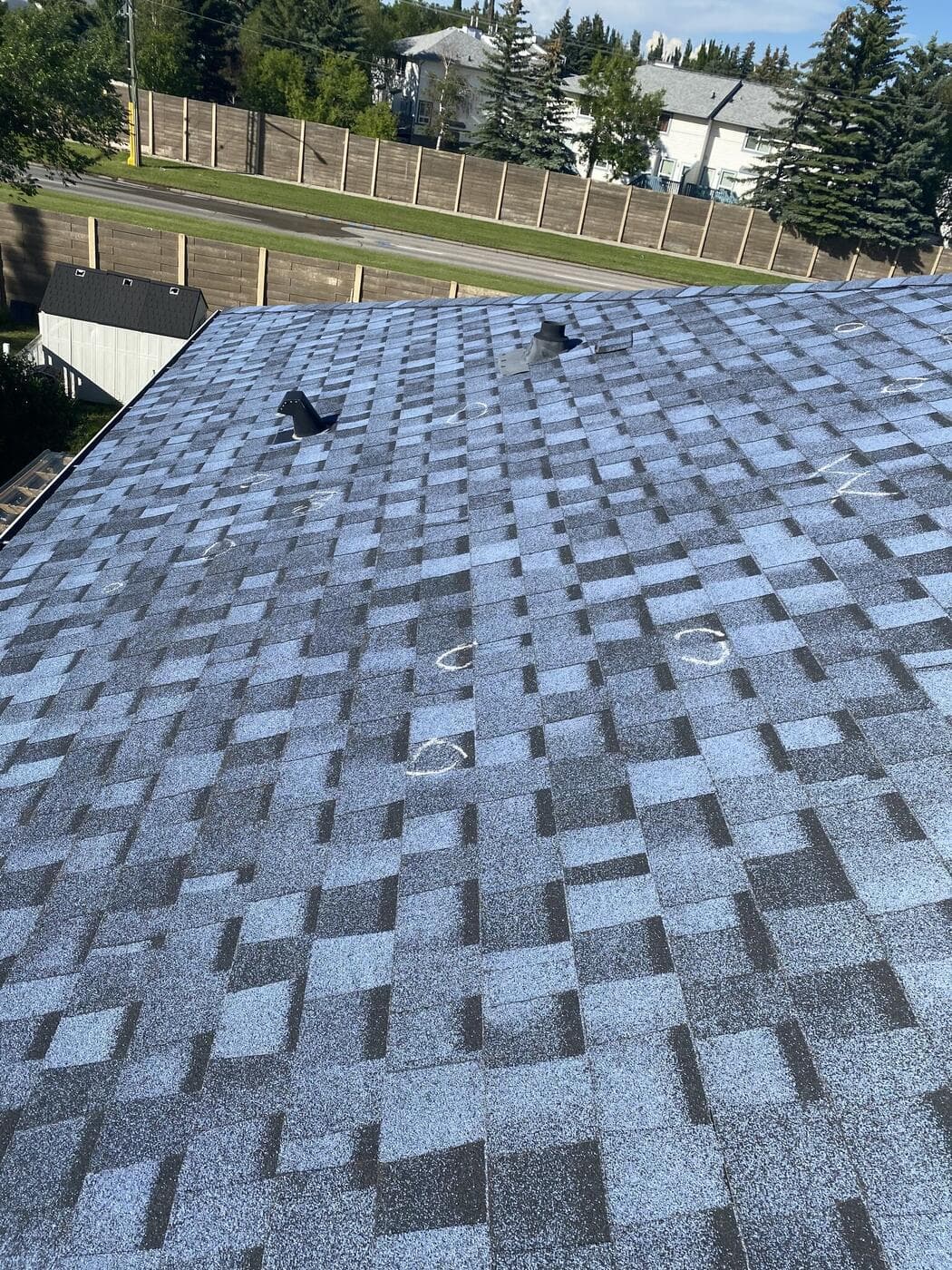
The Insurance Institute for Business & Home Safety (IBHS) lists these as the signs of hail on an asphalt shingle roof, and the metal on the house usually backs them up:
- A random pattern of marks across a slope, not a line or one cluster.
- Bruises: soft spots you can feel when pressing on the shingle, where the mat under the granules has fractured.
- Cracked or broken shingles, especially along the ridge caps.
- Dents on the metal: the top of the eavestrough, vent caps, fence caps and the air conditioner, on the side the storm came from.
- Chips, cracks or holes in siding and window screens, which often show before anything on the roof does.
Look from the ground, not from a ladder. What it looks like in photos is on our hail damage guide.
STRAIGHT ANSWERS.
How much did the August 2024 Calgary hailstorm cost?
CatIQ's final estimate, published in August 2026, is $3.349 billion in insured losses, covering home, commercial and vehicle claims. IBC reported more than 130,000 claims. It is the costliest hailstorm in Canadian history.
Is it too late to claim damage from the August 5, 2024 storm?
It depends on your policy and on when you found the damage. Alberta's statutory conditions require prompt written notice of a loss, and a court action over a property claim generally has to start within 2 years of when you knew or ought to have known about the damage. If you've only just found damage from this storm, report it now and ask your insurer what it needs. This is general information, not legal advice.
How do I show the damage came from this storm and not from age?
Hail leaves a recognisable pattern: random impacts, granule loss at the strike points and bruising you can feel, plus dents on the soft metals, which reads differently from even weathering. A report that photographs that pattern slope by slope, with scale references, and reasons from it to a dated storm is what ties damage to a date of loss. An assertion without that reasoning is not documentation.
My roof was replaced after this storm. Should I still get it looked at?
It can be worth it. Vents, flashing, skylights, eavestrough and siding take hail on their own, and they can be left out of a roof-only scope. If anything on the house wasn't replaced, it's worth a look.
Why did the estimate for the August 5, 2024 storm change?
First reported at nearly $2.8 billion, then $3.25 billion in February 2025 and $3.29 billion in August 2025, before CatIQ's final estimate of $3.349 billion in August 2026. The latest figure is $3.35 billion, published August 2026. Insured-loss estimates are revised as claims are counted and closed, so an early number is rarely the final one.
WAS YOUR ROOFIN ONE OF THESE?
Tell us the storm date and your address. We'll document what's actually on the roof.