
General information about how home insurance claims commonly work in Alberta. Your own policy wording decides what's covered, so read it and ask your insurer or broker to confirm anything that matters to you.
Haag is a forensic engineering and consulting firm whose education programs certify damage inspectors. Haag says its certifications are designed for field adjusters, estimators and consultants, and that inspectors have earned more than 30,000 of them. A HAAG-certified inspector has completed that training and assesses damage against Haag’s published methodology.
One clarification first, because it gets misused: HAAG certification belongs to individuals, not companies. Haag’s published designation guidelines describe its certification as an individual credential that may not be used to promote a company. The accurate statement is that an inspection was performed by a HAAG-certified inspector, which is how we describe ours.
Why methodology beats assertion
The core problem in a disputed hail claim is usually not dishonesty. It’s that two people are using different definitions of damage and reaching different conclusions in good faith. A contractor letter saying “this roof has hail damage and needs replacement” gives an adjuster nothing to reason from. It’s a conclusion without a method, so the only available response is to disagree with it.
Assessing to a published standard the reviewing adjuster can check narrows that kind of dispute. You’re no longer arguing about what counts as damage; you’re both reading the same definitions.
What’s in the report
A properly built damage report contains:
- Property identification, date of inspection, and the storm date being assessed against.
- A slope diagram identifying each elevation by direction, with test square locations marked.
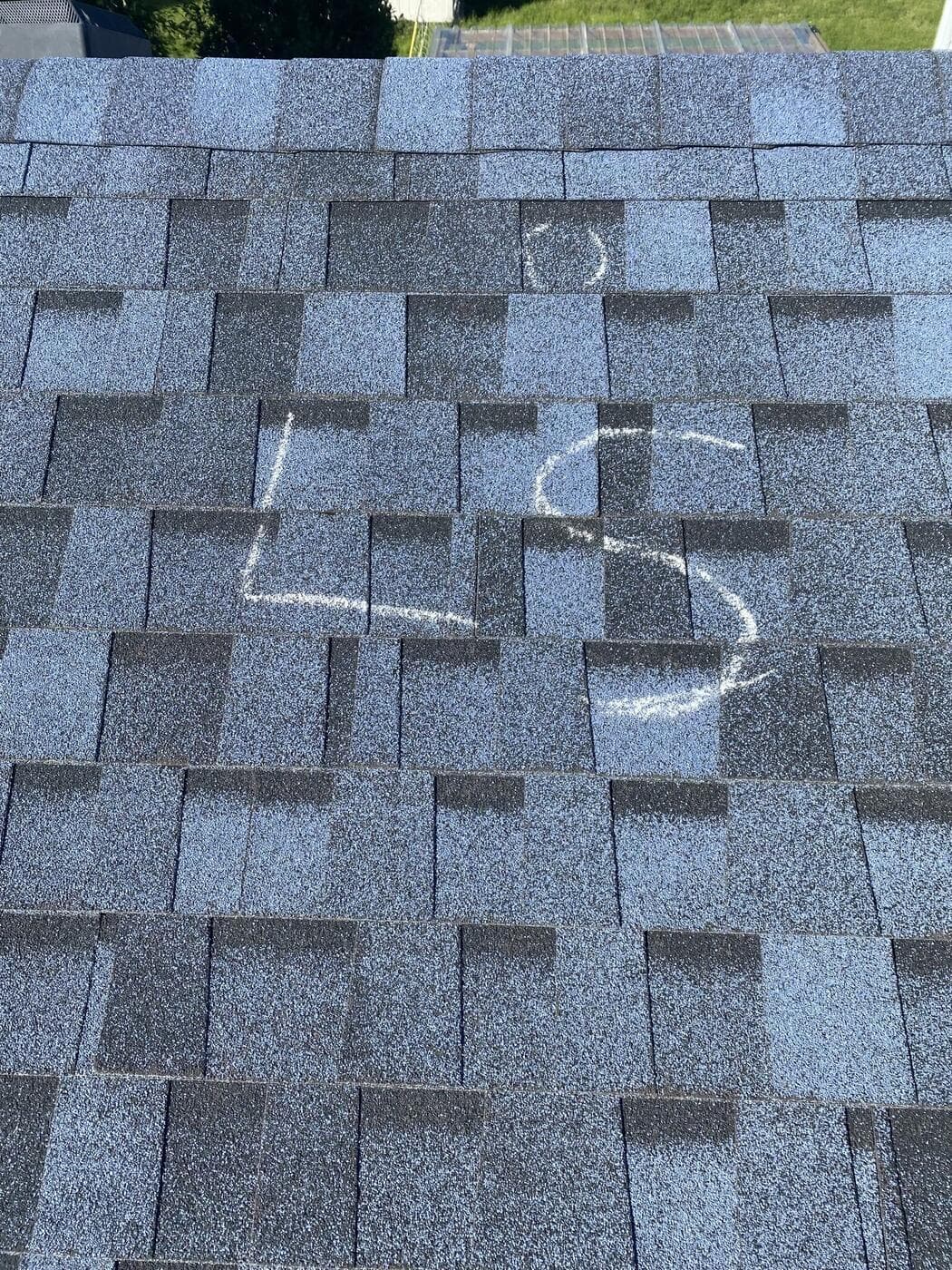
- Test square documentation per slope: placement, dimensions, and qualifying impact counts.
- Photographs keyed to the diagram, taken with a scale reference so an impact’s size is measurable rather than described.
- Assessment of collateral and soft-metal damage: gutters, downspouts, vents, flashings, AC condenser fins, fence caps, window wraps.
- Directional analysis: which elevations show impact, and whether that’s consistent with the storm’s track.
- Explicit separation of storm-related damage from pre-existing conditions, wear, and mechanical or foot-traffic damage.
- An itemised scope of the work the damage requires.
- Date-of-loss reasoning where multiple storms are plausible, which in Calgary is most of the time.
The date-of-loss problem, which is specifically a Calgary problem
A claim is written against one date. A Calgary roof may have been under the June 2020 storm, the July 2021 storm, the August 2024 storm and the July 2025 storm. Hail damage doesn’t carry a timestamp, so establishing which event caused what is a reasoning exercise: damage severity and pattern matched against documented storm tracks, hail sizes and the roof’s own age and history. A report that names a date without showing that reasoning is asserting, not documenting.
What an honest report says when there’s nothing there
That there’s nothing there. This is the part that decides whether a report is worth anything: an inspector who has never once written a negative finding isn’t assessing roofs, and adjusters can tell. A report that says “no functional hail damage identified; observed granule loss is consistent with normal weathering for a roof of this age” is a more valuable document than a marginal approval, because it’s the thing that makes the *next* report credible.
Will my insurer accept a HAAG report from a contractor?
There’s no guaranteed acceptance and anyone promising one is overselling. What the methodology does is make the report reviewable on its own terms. The adjuster can check the test squares, look at the photographs, and agree or disagree with specifics rather than with a bare conclusion. That’s what moves files.
Is a HAAG report the same as an engineering report?
No. Insurers sometimes commission a professional engineer’s report on a disputed claim, which is a different and more formal document. A HAAG-certified inspection is a damage assessment to a published standard. When a file needs a formal engineering opinion, that’s the document to get.
Do I get the report even if you don’t do the work?
You should. A report prepared on your roof is yours to keep and use, including if it says your roof is fine, and including if you take it to another contractor. Ask about that before any inspection, with any company.
Can you re-document a claim someone else already inspected?
Yes, second-opinion work is normal. We document what’s there now and state clearly where our findings differ and why, with the evidence. We won’t characterise another inspector’s work beyond what the evidence supports.
Where the facts on this page come from. If a source has changed since we last checked, tell us and we'll fix the page.
- Haag Certified Master Level: raising the bar in damage assessment · Haag
- HCR designation usage guidelines · Haag
- Is it hail damage? · Insurance Institute for Business & Home Safety
- Insurers to pay a record $1.2 billion to Albertans recovering from Calgary hailstorm · Insurance Bureau of Canada
- Summer storms across Western Canada result in over $300 million in insured damage · Insurance Bureau of Canada
- CAD 3.29B: CatIQ discloses updated industry loss for the Calgary hailstorm of August 5, 2024 · CatIQ
- Latest hailstorm in Calgary causes $92 million in insured damage · Insurance Bureau of Canada