
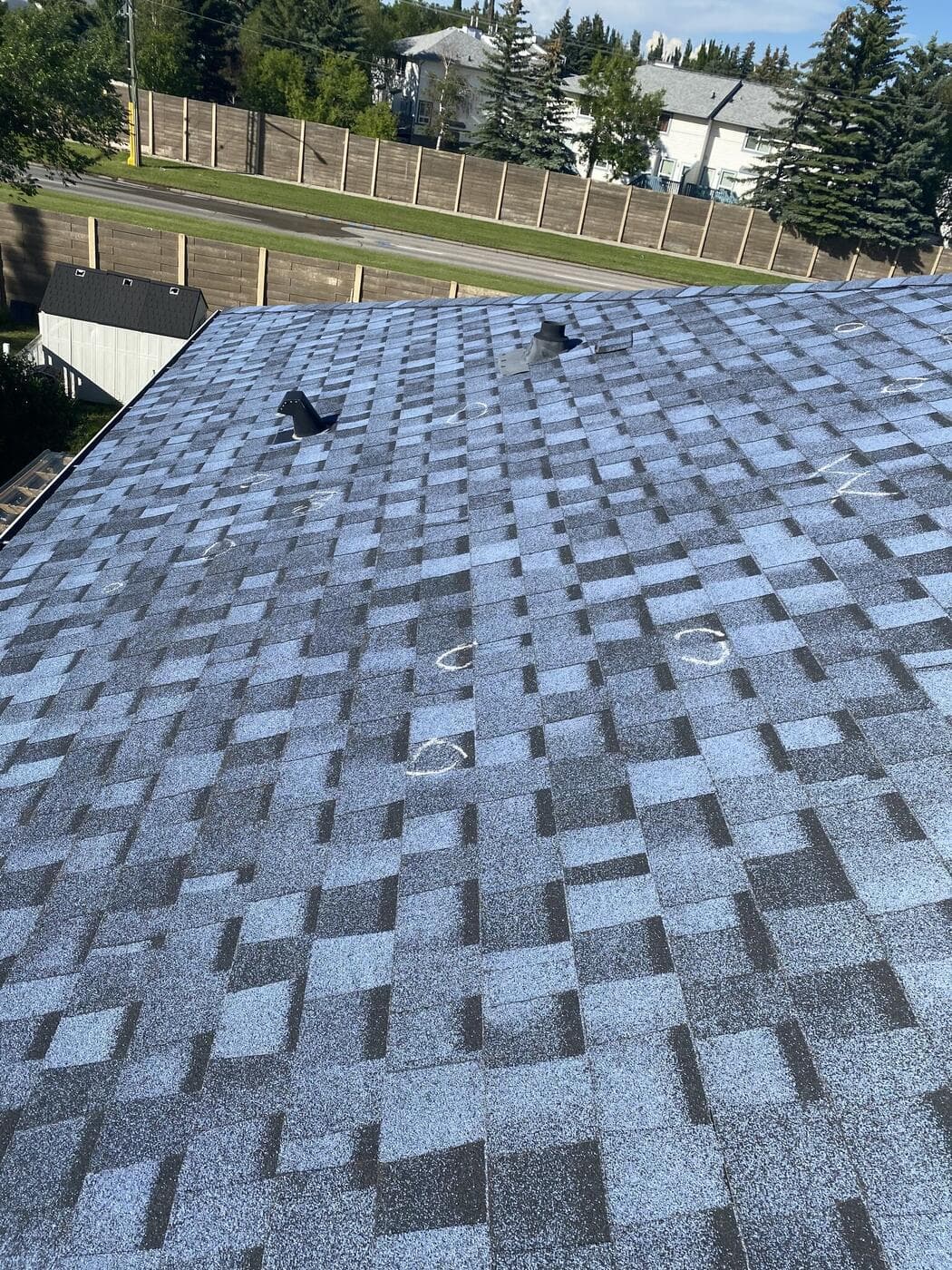
Calgary winters rarely bury houses the way they do in snowier parts of Canada. Chinooks melt a lot of what falls. But heavy spring storms can still drop wet, dense snow, and strong winds are a year-round fact of life here.
This guide explains how the building code decides what a roof has to carry, what that means in plain numbers, when snow on your roof is actually a concern, and why wind tends to peel roofs from the edges. It's aimed at homeowners, not engineers. If you ever suspect a structural problem, that's a job for a professional on site.
What snow load is
Snow load is the weight of snow and ice pressing down on a roof. Building codes measure it in kilopascals (kPa). One kilopascal is about 102 kilograms spread over each square metre, or roughly 21 pounds per square foot.
The code starts with the ground. National Research Council (NRC) climate data gives each location a ground snow load, called Ss, based on the snowpack expected to be exceeded only once in 50 years on average. It adds a rain load, called Sr, for rain soaking into that snow. A designer then adjusts those numbers for the roof itself.
| Value | Calgary | What it means |
|---|---|---|
| Elevation | 1045 m | Height the values are based on |
| Ground snow load, Ss (1-in-50 year) | 1.1 kPa | About 112 kg per square metre of snow on the ground |
| Rain on snow, Sr (1-in-50 year) | 0.1 kPa | Extra weight from rain held in the snow |
| Hourly wind pressure, one-in-ten-year | 0.38 kPa | Used for some serviceability checks |
| Hourly wind pressure, 1-in-50 year | 0.48 kPa | Used to design against wind loads |
How the code turns that into a roof load
The National Building Code calculates the specified snow load on a roof as S = Is x [Ss x (Cb x Cw x Cs x Ca) + Sr]. The letters are adjustment factors:
- Is (importance): higher for buildings like hospitals, lower for some minor buildings.
- Cb (basic roof factor): reflects that roofs usually hold less than the ground. On a house-sized roof it's commonly 0.8.
- Cw (wind exposure): open, windswept roofs hold less snow than sheltered ones.
- Cs (slope): steeper, slippery roofs shed snow.
- Ca (accumulation): raises the load where snow drifts or slides, such as below a higher roof or beside a dormer.
Wet snow versus dry snow
Depth alone tells you very little. Fluffy, cold snow is mostly air. Snow that has settled, been rained on or fallen wet in spring packs far more water into the same depth.
An NRC-published survey of roofs in deep-snow areas of British Columbia found that at high loads, roof snow had a density of about 400 kg per cubic metre, roughly a third higher than average code values. At that density, a load of 1.1 kPa, the same as Calgary's ground snow load, is only about 28 cm of snow. Fresh, dry powder weighs a small fraction of that, so the same weight would be a much deeper layer.
That's why a heavy, wet March or April storm, or rain falling on an existing snowpack, deserves more attention than a deep but light January dump.
When to remove snow, and how to do it safely
For most Calgary houses, rarely if ever. Roofs are designed with margin, and chinooks and sun clear a lot of snow between storms. Removing snow has real risks: falls, damaged shingles and eavestroughs, and sudden slides onto people below.
It's worth considering when there's unusually deep or wet buildup, heavy drifting against a higher wall, snow piling on a low-slope or flat roof, or any of the warning signs below.
- A ridge or roof line that looks like it's sagging.
- New cracks in drywall or plaster ceilings, especially upstairs.
- Interior doors near the top floor that suddenly stick or won't latch.
- Creaking, popping or cracking sounds from the attic or ceiling.
- Water stains or leaks appearing during a heavy snow period.
- If you see signs of structural stress, get everyone out of the affected rooms and call a professional. Don't go up there.
- For ordinary buildup, work from the ground with a long-handled roof rake with a plastic or rubber edge.
- Pull snow down in thin layers and leave a few centimetres on the shingles so you don't scrape off granules.
- Clear evenly, so one side isn't loaded while the other is bare.
- Keep the area below clear of people, pets and cars, and stay away from power lines.
- Leave ice alone, and hire an insured roofer with fall protection for anything that needs someone on the roof.
Wind ratings versus Calgary gusts
Calgary gets strong wind. According to the Government of Alberta, in most of the province a wind warning is given for winds expected to reach at least 70 km/h or gusts of at least 90 km/h, and the Canadian Encyclopedia puts chinook gusts at up to about 100 km/h.
Shingles are tested and rated for wind. As an example, IKO lists its Nordic shingle as meeting ASTM D3161 Class F and ASTM D7158 Class H wind resistance, with a limited wind warranty to 210 km/h. On paper, that's well above a typical Calgary windstorm.
The catch is that a rating describes a correctly installed, fully sealed shingle. Real roofs lose shingles in gusts far below their rating when the sealant never bonded, when the shingle has aged and gone brittle, or when the nailing was wrong.
Why roof edges fail first
Wind flowing over a house doesn't pull evenly on the roof. As it hits the wall and rolls over the eaves, rakes (the sloped side edges) and ridge, the air speeds up and swirls, creating stronger suction there than in the middle of a slope. Corners, where two edges meet, see the worst of it. That's why the National Building Code treats roof corner and edge zones separately when it sets wind pressures.
Edges are also where the details matter most. The starter strip, the first course of shingles, the drip edge and the ridge caps all have to be fastened and sealed properly. According to the Asphalt Roofing Manufacturers Association, shingle sealant is thermally activated, so a roof finished in cold weather may not bond until warmer days arrive. A lifted edge gives the wind something to grab, and once one tab goes, the ones above it follow.
What is the snow load for Calgary?
The National Building Code of Canada 2020 lists a 1-in-50-year ground snow load of 1.1 kPa for Calgary, plus a rain load of 0.1 kPa. A designer adjusts that for each roof's shape, slope, exposure and drifting.
How much snow can my roof hold?
It depends on how the roof was designed and on the kind of snow, not just its depth. Dense, wet snow weighs far more than powder. A roof in good condition built to code has margin, so a normal Calgary snowfall isn't a concern. Unusual buildup or signs of sagging are worth a professional look.
Should I shovel snow off my roof in Calgary?
Usually not. Most Calgary roofs never need it. If you do need to clear heavy buildup, use a roof rake from the ground and leave a thin layer on the shingles. Don't climb onto a snowy roof.
What wind speed damages shingles?
Properly installed, sealed shingles are rated for winds far stronger than a typical Calgary storm. Damage at lower speeds usually means the seal failed, the shingles are old and brittle, or the nailing or edge details weren't right.
What are signs of too much snow on a roof?
A sagging ridge or roof line, new ceiling cracks, doors upstairs that suddenly stick, and creaking or cracking sounds. If you see those, keep people away from the area and call a professional.
Where the facts on this page come from. If a source has changed since we last checked, tell us and we'll fix the page.
- National Building Code of Canada 2020, Volume 1 (Sentence 4.1.6.2.(1) and Appendix C, Table C-2) · National Research Council Canada
- National Building Code – 2023 Alberta Edition · National Research Council Canada
- Deep snow in British Columbia: survey implications for the National Building Code of Canada (Taylor, 1997) · NRC Publications Archive
- Tornadoes and extreme winds · Government of Alberta
- Chinook · The Canadian Encyclopedia
- Nordic shingles · IKO
- Recommendations for installation of asphalt roofing shingles in cold weather · Asphalt Roofing Manufacturers Association