
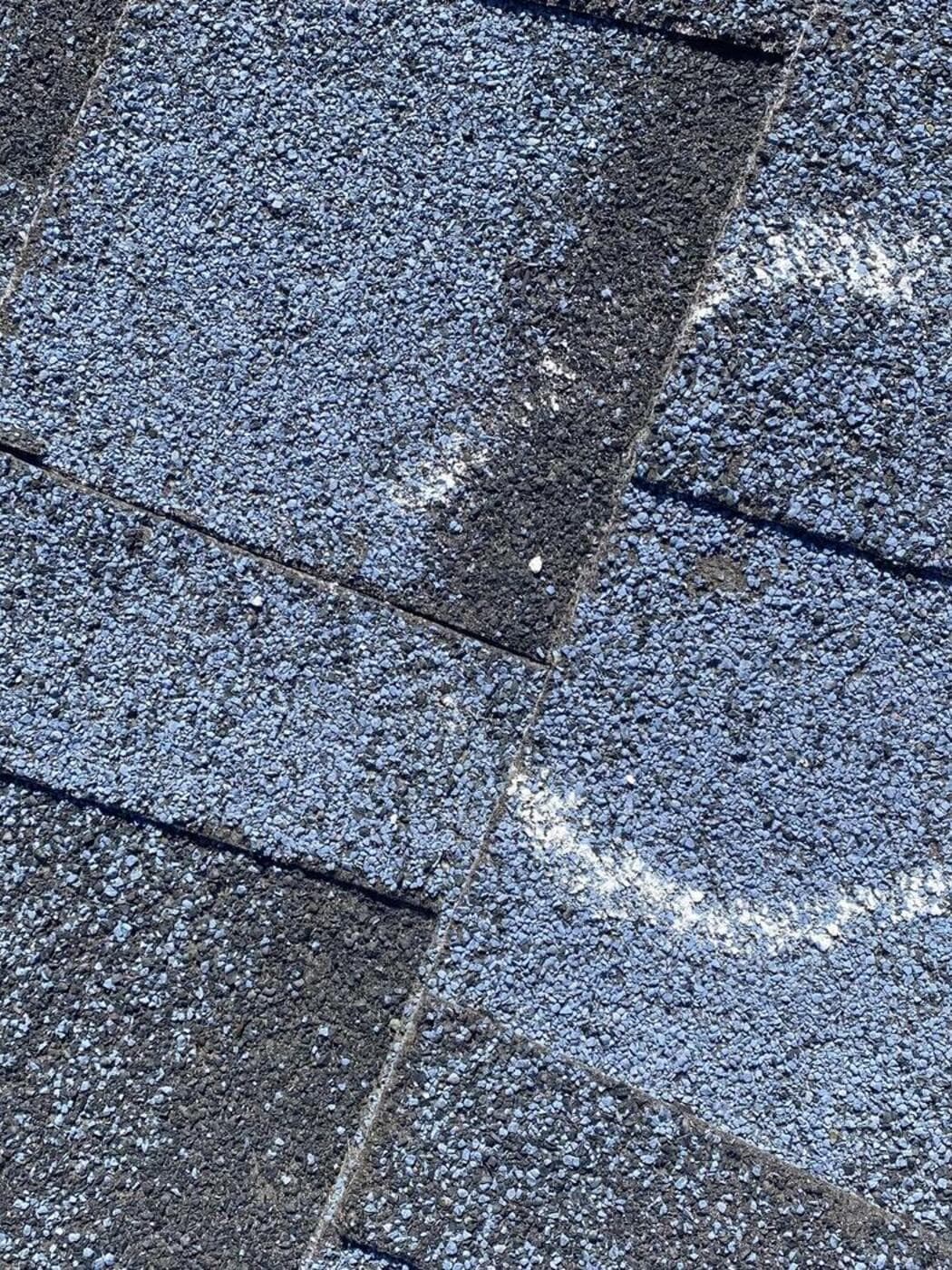
If you live in Calgary, hail is a regular summer event. Most years bring at least one storm somewhere in the region that does real damage to roofs, siding and cars.
This guide explains why that happens here in particular, when to expect it, how to make sense of the hail sizes you hear about in warnings, and what the major storms have cost. None of it will stop the next storm. It will help you understand the roof you own and act sensibly when the sky turns green.
Why the foothills build so much hail
Hail forms inside thunderstorm clouds. Strong updrafts, which are rising currents of air, carry raindrops high into the cloud where it's well below freezing. The drops freeze, pick up more supercooled water, and grow in layers until they're too heavy for the updraft to hold. Then they fall. Environment and Climate Change Canada says hail can reach the ground at speeds of up to 100 km/h or more.
Alberta's geography is close to ideal for that process. The Insurance Bureau of Canada (IBC) describes it simply: mountains and elevation create moist air near the ground with very cold, dry air above it. On summer afternoons the sun heats the land, warm moist air rises along the foothills, and storms can grow tall enough to reach the cold air aloft. The Canadian Encyclopedia notes that while hail happens in every province, it's most frequent and severe in Alberta and Saskatchewan.
- Uplift: air pushed up the slopes of the foothills gets storms started.
- Heat and moisture: long summer days load the lower air with energy.
- Cold air aloft: the colder the upper cloud, the more room a hailstone has to grow before it falls.
When the season runs
Hail can fall in any warm month, but the damaging storms cluster in summer. The insurer-funded Alberta Hail Suppression Project was set up to run through the summer storm season, with operations continuing to September 15. Intact Financial Corporation describes July as typically the most active month for hail, and the Canadian Encyclopedia notes that in central Alberta the most severe storms come in July and August, mostly from late-afternoon or evening thunderstorms.
That timing lines up with Calgary's recent history. The big insured-loss storms of the last several years landed on June 13, July 2, July 13 and August 5.
Hail sizes, and what they mean for a house
Warnings and news reports describe hail by comparing it to everyday objects. The sizes below come from the U.S. National Weather Service's standard descriptor chart, converted to centimetres. The right-hand column is a general guide from the roofing side, not a rule. Wind, the age of the roof and the angle of impact all change the outcome.
| Name | Diameter | What it usually means for a house |
|---|---|---|
| Pea | about 0.6 cm | Rarely damages a sound roof. Can mark soft metals. |
| Dime to quarter | about 1.9 to 2.5 cm | Dents eavestroughs, vents and screens. Older, brittle shingles may start to show damage. |
| Golf ball | about 4.4 cm | Can bruise or crack standard shingles and crack vinyl siding. |
| Hen egg to tennis ball | about 5 to 6.4 cm | Serious roof, siding and window damage is likely. |
| Baseball and larger | about 7 cm and up | Can punch through siding and break windows. Don't read any shingle rating as protection from hail this size. |
The major Calgary storms and what they cost
Insured losses are published by IBC using estimates from Catastrophe Indices and Quantification Inc. (CatIQ). They cover insured damage only, not uninsured losses. They also get revised, often sharply. The July 2021 storm was first estimated at $247 million and later passed $600 million.
The Calgary storm archive keeps these figures with their sources and the date each estimate was published. Use it when you need to pin down a date of loss.
- IBC ranks the August 2024 storm as the second-costliest insured disaster in Canadian history, far larger than the 2020 storm IBC had called the costliest hailstorm ever recorded in Canada. CatIQ reported hail up to baseball size in some areas.
- The July 2025 storm was mostly a vehicle event. IBC reported that vehicle damage made up more than half of all claims.
| Date | Area hit | Insured loss |
|---|---|---|
| June 13, 2020 | Northeast Calgary, Airdrie, Rocky View County | almost $1.2 billion |
| July 2, 2021 | Calgary (with flooding) | over $600 million |
| August 5, 2024 | Northern Calgary and Strathmore | $3.35 billion (CatIQ final estimate, August 2026) |
| July 13, 2025 | Calgary | $164 million (IBC, September 2025) |
Why losses keep rising
IBC reports that Alberta has had at least one major hailstorm every year for two decades, with more than $11 billion in insured damage over that time and $6 billion in the last five years alone. Across Canada, IBC puts insured losses from catastrophic weather events and wildfires at $37 billion from 2016 to 2025, compared with $14 billion over the previous decade, adjusted for inflation.
Some of that is exposure. A storm crossing a bigger city hits more roofs, more siding and more cars than the same storm would have a generation ago, and every one of those costs more to repair. IBC has called for Calgary to adapt to "our new weather reality", including requiring hail-resistant roofing and siding on new construction in high-risk areas.
For you, the practical result can show up in your policy, for example as a separate or higher hail deductible, or different terms for the roof. Check your declarations page at each renewal and ask your broker to explain any change. Percentage deductibles in Alberta explains how to read a hail deductible.
When is hail season in Calgary?
Damaging hail is mainly a summer event. July is typically the most active month, and in central Alberta the most severe storms tend to come in July and August. The insurer-funded hail suppression program runs into mid-September.
Why does Calgary get so much hail?
The city sits east of the Rockies, where summer heat, moisture near the ground and cold air higher up combine. Air pushed up the foothills starts storms that can grow tall enough to build hailstones.
What size hail damages a roof?
There's no single cut-off. Pea-sized hail rarely hurts a sound roof. Around quarter size you start to see dented metal and damage on older shingles, and golf-ball hail and larger can crack standard shingles and siding. Roof age and wind make a big difference.
What was the worst hailstorm in Calgary?
By insured loss, the August 5, 2024 storm over northern Calgary and Strathmore. Insured damage reached $3.35 billion (CatIQ final estimate, August 2026), and IBC ranks it the second-costliest insured disaster in Canadian history.
Does cloud seeding stop hail in Calgary?
No. The program seeds storms to try to reduce hail damage. Hail still falls and large storms still get through, and the Canadian Encyclopedia notes that controlled experiments elsewhere found no clear difference between hail from seeded and unseeded storms.
Where the facts on this page come from. If a source has changed since we last checked, tell us and we'll fix the page.
- Alberta continues to see large-scale impacts from hailstorms · Insurance Bureau of Canada
- Hail · The Canadian Encyclopedia
- Warm season weather hazards · Environment and Climate Change Canada
- The new Alberta Hail Suppression Project (Krauss and Renick) · Journal of Weather Modification
- Hail and strong winds preparedness hurdle: nearly 4 in 10 Canadians say they don't know where to start (news release, June 16, 2026) · Intact Financial Corporation
- Hail and wind descriptors · U.S. National Weather Service
- Insurers to pay a record $1.2 billion to Albertans recovering from Calgary hailstorm · Insurance Bureau of Canada
- Calgary hailstorm causes $247 million in insured damage (news release, August 4, 2021) · Insurance Bureau of Canada
- Summer storms across Western Canada result in over $300 million in insured damage · Insurance Bureau of Canada
- Cost of historic Calgary hailstorm continues to rise · Insurance Bureau of Canada
- Final industry loss estimate, 2024 Calgary hailstorm · CatIQ
- Cost of July Calgary hailstorm almost double initial estimates · Insurance Bureau of Canada
- Latest hailstorm in Calgary causes $92 million in insured damage · Insurance Bureau of Canada
- Severe weather-related insured losses in Canada exceed $2.4 billion in 2025 · Insurance Bureau of Canada