
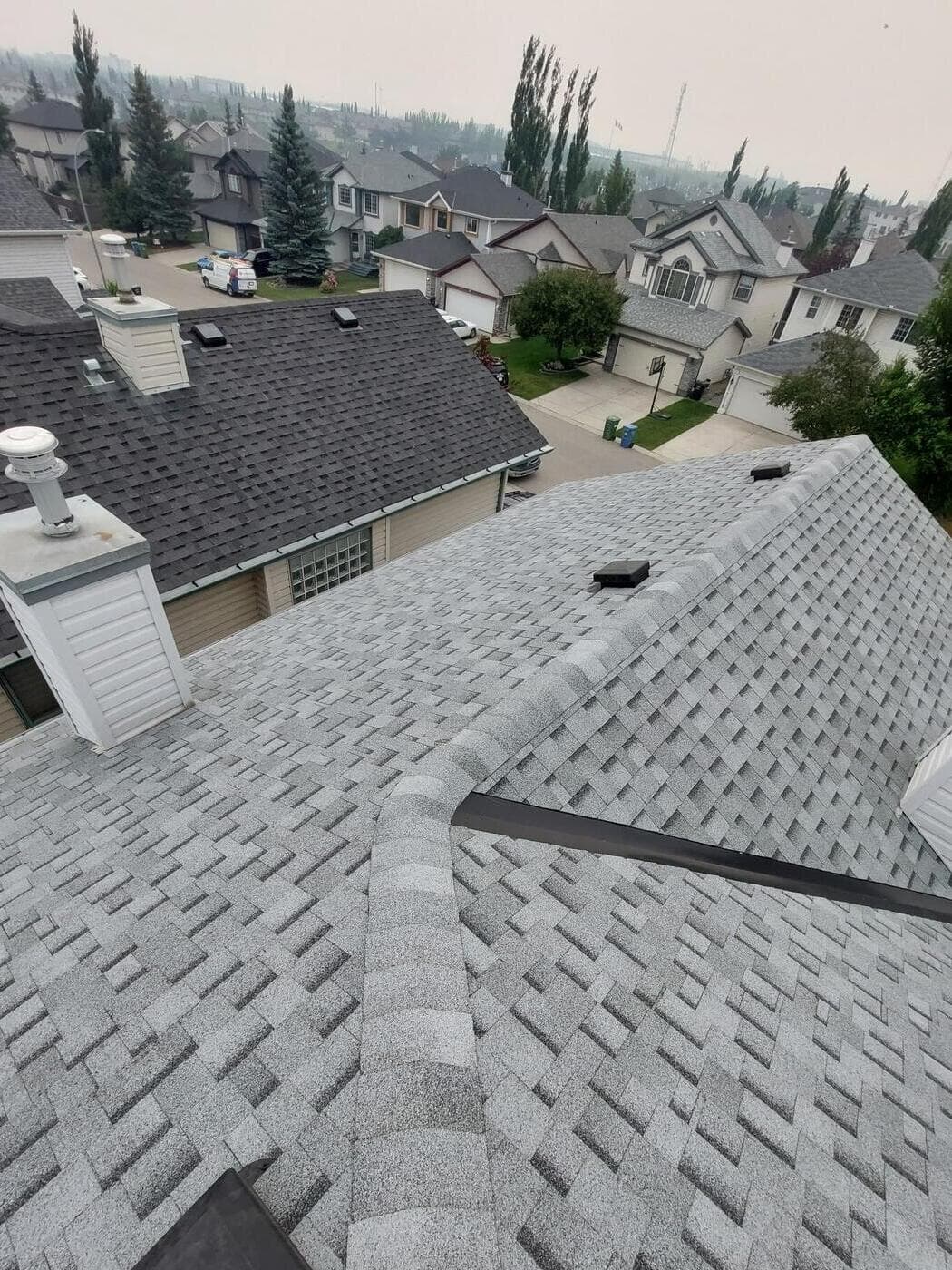
A roof collects a surprising amount of water. Every square foot of it drains to the edge, and without eavestroughs, all of that water drops in a line right beside your foundation, soaking the soil against your basement walls.
Eavestroughs (gutters, if you grew up somewhere else) catch that water and hand it to downspouts, which carry it away from the house. It's a simple system. It fails in simple ways too: too small, badly sloped, clogged, or discharging exactly where the water shouldn't go. For what the work costs, see the eavestrough cost guide.
Sizing the trough and downspouts
K-style is a common eavestrough profile, named for its shape, which looks a bit like crown moulding from the side. Troughs are described by the width across the top, and 5 inch and 6 inch are sizes you'll often see quoted.
How much water a system can carry depends on the roof area draining into each run, how steep the roof is, and the size and number of downspouts. A big trough draining through one small downspout can still overflow. The City of Calgary's Guide to Lot Drainage recommends that large roofs spread their water through multiple downspouts, spaced so runoff disperses evenly onto landscaped areas. Ask any installer how they sized the troughs and downspouts for your roof, especially where a valley sends a lot of water to one corner.
Seamless aluminum vs sectional
Seamless eavestrough is formed on site from a coil of aluminum, cut to the exact length of each run. The only joints are at corners and end caps. Sectional eavestrough comes in pre-cut lengths joined together every few feet with connectors and sealant.
Joints are a common place for eavestroughs to leak, and each one is worked by freeze-thaw cycles. That's a big part of why many homeowners choose seamless aluminum. Sectional can make sense for a short run or a quick repair. On a whole house, ask how many joints each option will have and how they're sealed.
Slope and downspout placement
An eavestrough isn't level. It's pitched slightly toward each downspout so water keeps moving. On a long run, installers often add a downspout at each end, with the trough sloping toward both. Ask your installer what pitch they use and where the outlets will go.
Too little slope leaves standing water that grows algae and freezes solid. Too much looks crooked from the street. Downspouts belong at the low ends of each run, and near any spot where a valley dumps a lot of water at once.
- Standing water in a clean trough means the slope is wrong or a hanger has sagged.
- Water pouring over the front at an inside corner usually means a valley is overwhelming that section.
- Drips behind the trough point to a gap between the roof edge and the gutter, often a drip edge problem.
Where the water goes: extensions, grading and Calgary's rules
The trough and downspout only move water off the roof. What happens at the bottom decides whether it ends up in your basement.
The City of Calgary's Guide to Lot Drainage recommends extending downspouts at least 4 to 6 feet (1.2 to 1.8 m) from the foundation so runoff doesn't recirculate down the wall and into the weeping tile, with a splash pad at the discharge to prevent erosion. The Government of Canada's flood-prevention guidance says at least 2 m from the foundation of all surrounding homes, where possible, toward an area that drains well, such as a planted area or rain garden.
The ground has to help. The City's guide calls for a minimum 4 per cent slope away from the foundation within the first 1.2 metres, about 4.8 cm of drop, and at least 2 per cent in grassed and landscaped areas. If the soil beside your house has settled toward the wall, extensions alone won't fix it.
Gutter guards
Gutter guards are screens, mesh or covers that sit over the trough to keep leaves and debris out. Under a big poplar or spruce, they can save a lot of ladder time. On an open lot with few trees, the trough may only collect shingle granules and dust, and guards add cost without much benefit.
Guards reduce cleaning. They don't eliminate it. Fine debris and seeds still collect on top, and some styles can hold snow and ice at the roof edge. If you install them, you still need to check the system the Government of Canada recommends looking at every spring and fall.
Ice in Calgary winters
Calgary eavestroughs live through a lot of freeze-thaw. Snow melts on a sunny afternoon or during a chinook, runs into the trough, and refreezes overnight. Some ice in the trough is normal. Problems show up when it builds.
- Frozen downspouts. Ice plugs the bottom, meltwater backs up, and the trough overflows or splits. Extensions that sit in shade or low spots freeze first.
- Heavy ice loads. Packed ice pulls hangers loose and bends the trough, especially where the fascia behind it is soft.
- Ice dams. Icicles and ice filling the trough are often a sign of heat escaping into the attic, not a gutter problem. See ice dams in Calgary.
- Icy walkways. The City's lot drainage guide warns against pointing downspouts at driveways and sidewalks, where the discharge can make them slippery.
How far should downspouts extend from the house in Calgary?
The City of Calgary's Guide to Lot Drainage recommends at least 4 to 6 feet (1.2 to 1.8 m) from the foundation. Separately, the Stormwater Bylaw requires downspouts to end at least 2 metres from any sidewalk, road, pathway, alley, lane or drainage facility.
Can my downspout drain onto my neighbour's property?
It shouldn't. The City of Calgary's Guide to Lot Drainage says runoff must be directed to the street, lane or swale and not toward an adjacent building or structure, and that lot drainage shouldn't adversely affect adjacent properties. Point downspouts toward the front or back of the lot.
Do I need 5 inch or 6 inch eavestroughs?
It depends on how much roof drains into each run, the roof's pitch, and the size and number of downspouts. Ask your installer how they sized it. The Government of Canada advises upgrading to a larger size if eavestroughs or downspouts consistently overflow in rain even with regular cleaning.
Are gutter guards worth it in Calgary?
Under large trees, often yes, because they cut down on cleaning. On open lots with few trees they add cost without much benefit. Either way they still need occasional checking, and some styles hold snow and ice at the edge.
Where the facts on this page come from. If a source has changed since we last checked, tell us and we'll fix the page.
- Stormwater Bylaw for homeowners · City of Calgary
- Bylaws related to stormwater · City of Calgary
- Guide to Lot Drainage · City of Calgary
- Eavestroughs and downspouts · Government of Canada